
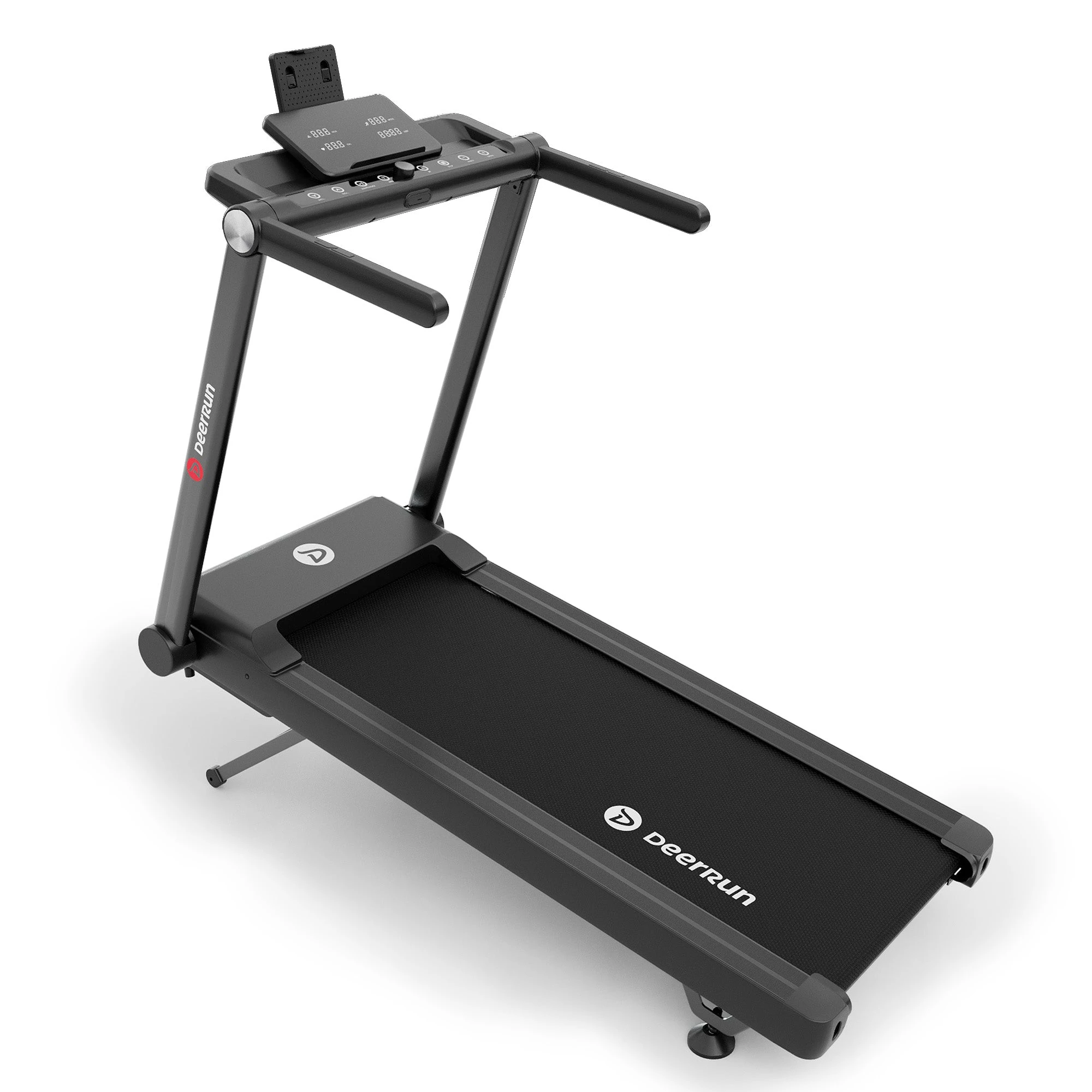
Your needs, this model
Does it fit your priorities?
Does the Rise meet a 400 lb load with 25% powered incline and 10 mph top speed?
The exact current U.S. page lists a 400 lb capacity, powered incline up to 25%, and a 0.6–10 mph range. A requirement beyond those published limits fails.
Explore this need in the finder →Can a requested 17-inch running-belt width be confirmed?
No. The exact product page gives folded and extended machine envelopes but does not publish the usable belt dimensions. Do not infer belt width from the product image.
Explore this need in the finder →Can the Rise operate with an existing height-adjustable desk?
Not on the reviewed evidence. The page describes an upright full-deck treadmill and includes only a small phone/pad stand; separate desk compatibility is unconfirmed.
Explore this need in the finder →The DeerRun Apex Rise 1 is an upright full-deck treadmill for users who want more climbing range than the Apex Base 1. Its U.S. listing pairs a 25% powered incline with speeds up to 10 mph and a 400 lb stated maximum. That is a more incline-focused home machine, not a desk-first walking pad, and the exact offer does not document an under-desk operating mode.
Why choose Rise over Base?
Both models top out at 10 mph, so the Rise is not the higher-speed choice. Its distinction is the steeper advertised incline ceiling: up to 25%, compared with Base 1’s 15%. DeerRun also lists 400 lb for Rise versus 350 lb for Base. If those two limits change your actual workout or the load the treadmill must permit, the Rise is the more relevant Apex option. If you will mostly walk on level ground, Base may already supply more incline and speed than you need; a larger specification is not automatically a better fit.
These values are the manufacturer’s published figures, not independent measurements or a guarantee of comfort at the maximum. The precise belt dimensions are not listed in the reviewed U.S. product page. Its imagery makes the full-size running surface clear, but cannot tell you its usable width or whether your own stride fits. If belt length or width is essential, request an exact specification before treating the Rise as a match.
Powered incline changes space and setup needs
A 25% motorized incline lets the workout add climbing without requiring the user to adjust a manual block between sessions. That can be useful when the workout itself is the purpose of the machine. It also makes the machine’s setup envelope and operating instructions more important. The manufacturer publishes folded and extended size strings, but does not label their axis order in the current page text. I preserve the two strings exactly rather than turning them into a claimed length, width or doorway fit. Check clearances at the actual incline positions and the delivered manual before placing it near furniture or a ceiling.
The manual book and quick guide appear in the package list, but no downloadable exact U.S. operating guide was available with the offer. Duty cycle, continuous session allowance, electrical requirements, maintenance intervals, incline clearance and supported storage orientation therefore remain unknown here. Do not infer that a frame described as foldable is safe to leave upright, or that a machine can be used with its supports lowered under a desk.
A holder is not a desk
The supplied-components list includes a phone/pad stand, safety lock, 5.9-foot power cord, lubricant, assembly tool, bolts, a booklet and a quick guide. A small device stand is useful for viewing content, but it is not a supplied typing surface. Nor does it show that an existing standing desk fits over the belt. The exact product is presented as a home running treadmill with a console; no separate lowered-rail plan, desk speed limit or user-desk compatibility is confirmed.
If your goal is walking while typing, use a model with an exact, documented desk arrangement, then check desk height and clearance. The Rise may be a better shape for dedicated home cardio than a compact walking pad, but it should not be included on a desk requirement just because it is foldable or has a screen holder.
Storage and delivery details need confirmation
DeerRun lists a folded size of 61.89 × 31.66 × 11.82 inches and an extended size of 61.89 × 45.36 × 31.66 inches. The changing middle and last values suggest a folding frame, but the page does not define the axes in its text. Plan with the complete machine, not the belt alone, and confirm the actual opened and stored envelope with the seller. The variant feed’s zero weight is not a meaningful treadmill weight, so lifting effort and stair handling cannot be answered from it.
The product page has an Add to cart control and the exact DR-AP02-Black Shopify option is marked available. It also retains old January 2026 preorder shipping dates. Because those dates have passed, the real dispatch date and current fulfillment should be checked at checkout. The page’s warranty and promotional language is not a substitute for the terms attached to the exact selected offer.
What your answers change
The Rise is a candidate when you need an upright rail-and-console workout, a published 400 lb allowance, powered incline up to 25%, and speeds up to 10 mph. A required desk mode, precise belt measurement or specific storage orientation removes it until the manufacturer confirms those details. Choose Base 1 when its 15% maximum and 350 lb limit are enough; choose Titan 1 only if its much steeper advertised climb, decline and 12.5 mph ceiling solve a real training need. For ordinary desk walking, favor an exact low-profile or hybrid arrangement whose manufacturer actually documents desk operation.
Key details at a glance
| Walking deck folds | No |
|---|---|
| Handrail supplied | Yes |
| Load configuration | The current exact U.S. manufacturer page lists 400 lb. This is the published limit, not an independent test; read the delivered guide and unit label. |
| Walking speed arrangement | The exact U.S. page lists 0.6–10 mph for the full upright machine. Desk-mode speed is unconfirmed because no desk arrangement is documented. |
| Incline mechanism | The current U.S. page gives a 0.6–10 mph range, 25% powered incline, 400 lb maximum user capacity, and folded/extended size strings of 61.89 × 31.66 × 11.82 and 61.89 × 45.36 × 31.66 inches. Those page strings do not label axes; they are preserved verbatim rather than mapped to body measurements. No exact usable-belt dimensions are listed. |
| Storage routine | The current U.S. page gives a 0.6–10 mph range, 25% powered incline, 400 lb maximum user capacity, and folded/extended size strings of 61.89 × 31.66 × 11.82 and 61.89 × 45.36 × 31.66 inches. Those page strings do not label axes; they are preserved verbatim rather than mapped to body measurements. No exact usable-belt dimensions are listed. Upright/vertical storage permissions and manual-based locking steps remain unconfirmed. The page provides a folded-size string but does not label axes; the profile does not convert it into a clearance field. The page provides a folded-size string but does not label axes; the profile does not convert it into a clearance field. |
| Configuration and availability | The U.S. offer has an Add to cart control and the exact Black Shopify variant is available=true. The page also retains January 2026 pre-order dates that have passed, so dispatch timing should be confirmed rather than inferred. |
| Activity watch included | No |
Use the exact model’s instructions for operating limits, supplied equipment and version differences.
Sources for this assessment

Find a walking pad for your real workspace.
Start with the load allowance, usable belt and storage routine, then add essential controls.