
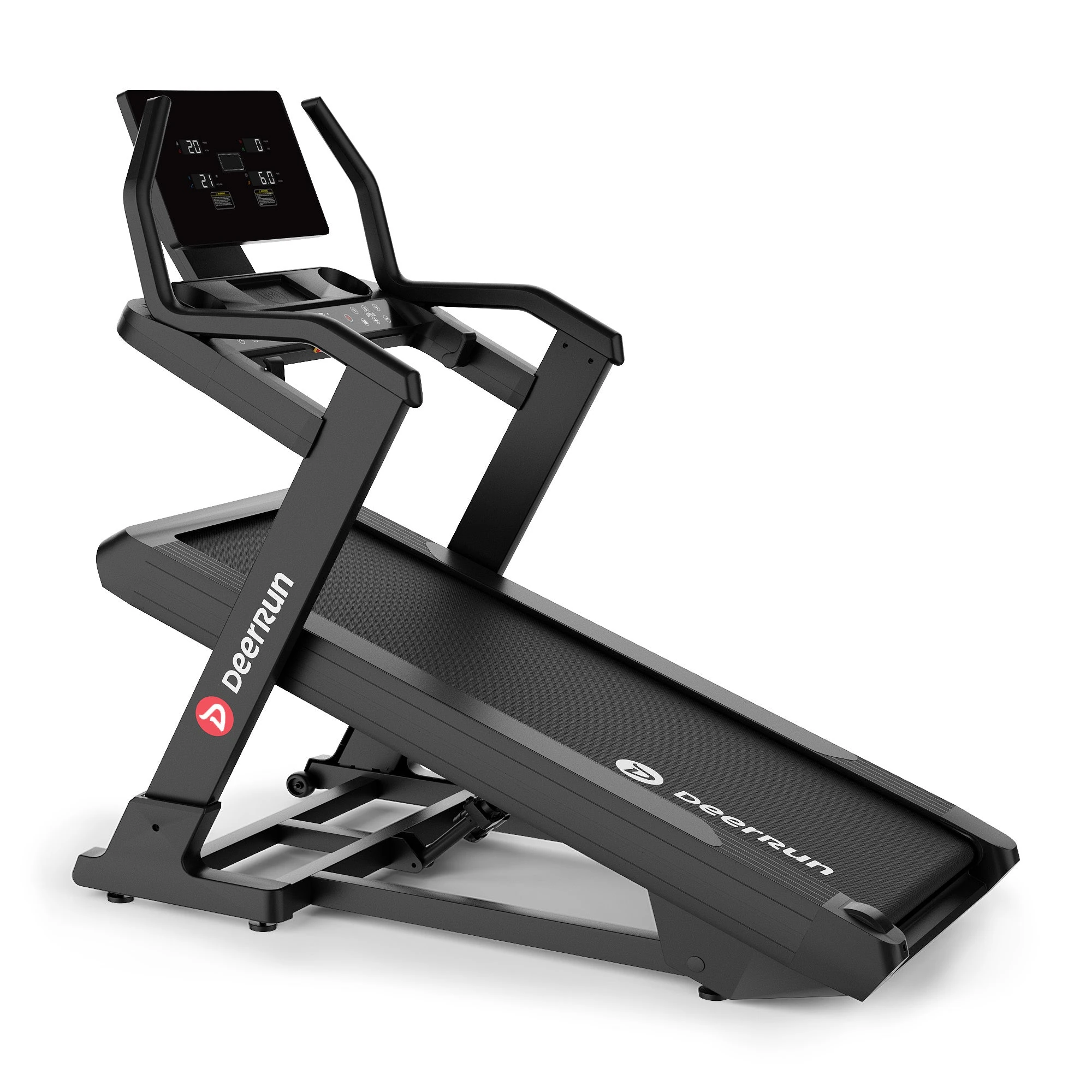
Your needs, this model
Does it fit your priorities?
Does the Titan meet 400 lb, 48% powered incline and 12.5 mph needs?
The U.S. page lists a 400 lb maximum, -6% to 48% automatic incline and 0.6–12.5 mph. Requests beyond the stated positive range are not supported.
Explore this need in the finder →Can it meet an essential desk-walking requirement?
No desk plan is confirmed. The exact page describes an upright terrain treadmill with full handrails and a console, not a workday walking pad.
Explore this need in the finder →Will an order arrive before December 10, 2026?
The current U.S. listing says pre-order item—ships starting Dec. 10. Earlier delivery is not established by the available variant flag.
Explore this need in the finder →The DeerRun Apex Titan 1 is the most specialized of the three Apex machines assessed here. Its U.S. page advertises powered incline from a 6% decline up to a 48% climb, a 0.6–12.5 mph range and a 400 lb user limit. Those headline figures point to terrain-style home training—not to the compact, desk-first movement this site primarily covers.
Buy the range only if you will use it
The Titan’s defining difference is not just a higher incline number. DeerRun lists both negative decline and a far steeper positive range, making it the only model in this small Apex group that claims downhills as well as very steep climbs. It also raises the top speed to 12.5 mph, compared with 10 mph for Base 1 and Rise 1. If you plan structured hill and decline sessions or need that running ceiling, those capabilities distinguish the Titan. If you simply want regular walking or a moderate incline, the Base or Rise avoids paying attention to a capability you may never use.
The page gives a 400 lb maximum user allowance. That is a manufacturer statement, not an independently tested load rating or a personal safety recommendation. It does not describe belt length or width in the text I could confirm. The product image is a large full-deck treadmill, but photography cannot establish usable running space. If the deck size, doorway, ceiling clearance or turning area is close, get the exact assembled measurements and the incline envelope before deciding.
It is a workout machine, not a desk solution
The exact page shows full-height supports, multiple handholds and a console, and describes this as a terrain treadmill for home workouts. It does not document a lowered-rail mode beneath an existing desk, a desk speed cap or compatibility with a separate workstation. A user who must walk while typing should not treat this as compatible based on the presence of slow speeds or an image of an empty room. That essential use remains unconfirmed.
The page’s product size appears as 61.10 × 34.49 × 65.16 inches, but the text does not label the three axes. It does not provide a folded envelope or state that vertical storage is allowed. Rather than guessing an axis order, verify the assembled dimensions, rail footprint, clearance at full incline and storage instructions for the delivered version. This is a substantial machine concept; do not assume it can be parked beneath a desk or carried upright simply because the listing calls it a slim profile.
Connected features are claims, not test results
The product page advertises a brushless motor and PitPat connected features, including workout tracking and virtual running. Those are manufacturer descriptions. No independent noise, stability, heat or live app test is claimed here, and a “quieter” marketing statement is not a promise that neighbors will not hear a steep workout. The console and heart-rate material shown on the offer do not confirm the contents of the package or every control command.
Unlike the Base 1 and Rise 1 pages, the inspected Titan offer does not provide a detailed component list or a downloadable model-specific U.S. manual. Do not assume the safety key, lubrication, tools, workout hardware or accessory package matches the other Apex boxes. Assembly steps, electrical requirements, stop procedure, duty cycle, session limit, incline clearance, care interval and safe storage all require the exact instructions and seller confirmation.
The future ship date matters
This is currently presented as a pre-order, not an immediately stocked treadmill. The U.S. page says it ships starting December 10, 2026, and warns that an order cannot easily be modified or canceled. The exact variant feed’s available flag does not turn that into in-stock inventory; the more specific page status controls this assessment. If the order is still available later, check the current ship estimate, cancellation terms and warranty for the selected U.S. option before committing. The site’s generic Amazon search is not evidence that a particular seller has the exact machine ready to ship.
What your answers change
The Titan is relevant only when extreme incline/decline and a 12.5 mph ceiling solve a real training objective, the 400 lb published limit is sufficient, and the room can accommodate an upright machine. A required desk arrangement, known belt measurement or immediate delivery is not satisfied by the reviewed evidence. The Rise 1 offers a less extreme 25% incline and 10 mph range; Base 1 is the simpler 15%/10 mph entry. For workday walking, choose a low-profile or hybrid machine with a documented desk plan instead of selecting the largest range by default.
Key details at a glance
| Handrail supplied | Yes |
|---|---|
| Load configuration | The current exact U.S. manufacturer page lists 400 lb. This is the published limit, not an independent test; read the delivered guide and unit label. |
| Walking speed arrangement | The exact U.S. page lists 0.6–12.5 mph for the full upright machine. Desk-mode speed is unconfirmed because no desk arrangement is documented. |
| Incline mechanism | The U.S. offer lists -6% decline to 48% automatic incline, a 0.6–12.5 mph range, 400 lb maximum capacity and product size string 61.10 × 34.49 × 65.16 inches. Axis labels, usable belt size and a safe storage envelope are not published in the inspected page text. |
| Storage routine | The U.S. offer lists -6% decline to 48% automatic incline, a 0.6–12.5 mph range, 400 lb maximum capacity and product size string 61.10 × 34.49 × 65.16 inches. Axis labels, usable belt size and a safe storage envelope are not published in the inspected page text. Upright/vertical storage permissions and manual-based locking steps remain unconfirmed. |
| Configuration and availability | The exact U.S. offer calls this a pre-order and states that it ships starting Dec. 10, 2026. The variant feed marks its default-title variant available=true, which does not override the explicit pre-order status. Do not treat the product as immediately in stock or assume the future date cannot change. |
Use the exact model’s instructions for operating limits, supplied equipment and version differences.
Sources for this assessment

Find a walking pad for your real workspace.
Start with the load allowance, usable belt and storage routine, then add essential controls.