
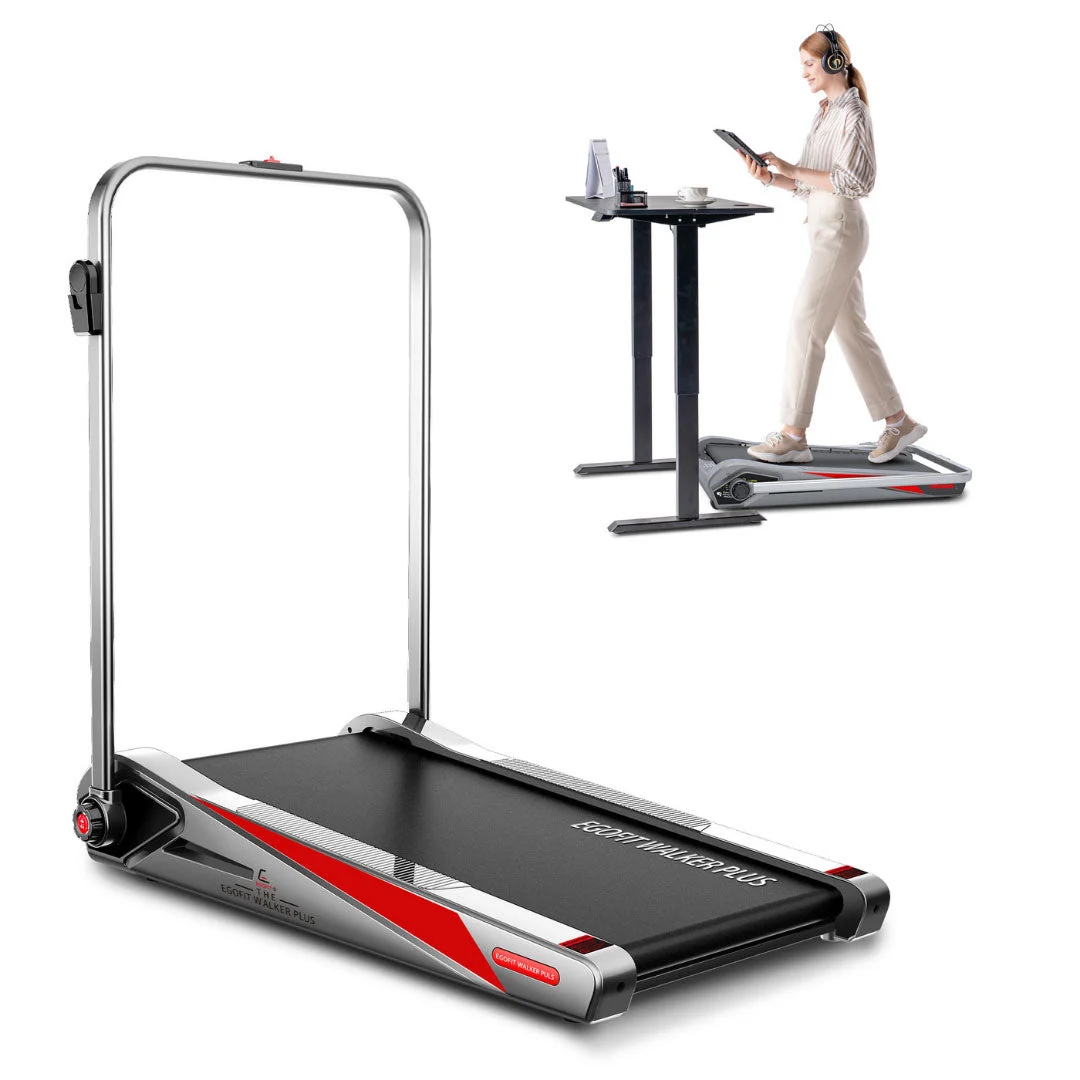
Your needs, this model
Does it fit your priorities?
Can it walk at 3.7 mph with an upright rail?
The rail-up range reaches a documented 3.73 mph.
Explore this need in the finder →Can I require a fixed slope and a supplied handrail?
The rail-up M1T retains the fixed 5% incline.
Explore this need in the finder →Does the walking deck fold shorter for storage?
No. Its handrail folds; the walking deck remains solid.
Explore this need in the finder →The Egofit Walker Plus M1T adds a folding handrail to the short, fixed-incline idea of the M1. It makes sense when you want desk walking and a separate rail-up walking routine in the same compact machine. The handrail changes its footprint and operating limits; it does not turn the short belt into a full-size running deck.
Two rail positions need two separate plans
Egofit specifies 0.62–3.11 mph for the lower configuration and up to 3.73 mph with the handlebar opened. The supplied M1/M1T manual also distinguishes the models' speed ranges. The useful distinction is that the higher figure belongs to the supported rail-up arrangement. Do not assume the highest advertised speed and a low, unobstructed under-desk profile are available together.
For desk use, first confirm how the folded rail fits around your desk legs and supporting bars. For rail-up use, choose a clear walking location and follow the safety-key instructions. A rail is an operating component, rather than an assurance that the treadmill is suitable for anyone who needs balance assistance. Its presence is not a medical suitability assessment.
The short belt is the space-saving compromise
The M1T walking area is 34.25 by 16.54 inches, the same published belt size as the M1. That short deck can suit an office where a roughly 57 inch open WalkingPad would dominate the floor. It also leaves less front-to-back walking space. Your ordinary outdoor stride or height cannot establish whether that belt will feel comfortable during a particular desk task.
Measure the body and the walking surface separately. Egofit lists the lowered arrangement at 40.55 by 26.18 by 6.89 inches. The handrail hardware makes it wider than the M1. A desk opening that accommodates the rail-free model may therefore be unsuitable for the M1T, even though the walking areas match.
A fixed 5% slope is part of every session
The M1T retains a fixed 5% incline. There is no flat choice to select when working at the desk. Someone who wants a level belt should shortlist a documented level configuration instead. The smaller percentage on the newer M2T describes a different fixed incline, rather than an adjustment setting on this machine.
Choosing an incline should be deliberate. We do not adopt claims that it will relieve pain, protect joints or produce a specific calorie result. Those promises would require evidence beyond a product description. The practical question here is whether a permanent slope fits your intended use and whether your desk adjusts sufficiently for the walking position it creates.
Capacity, controls and storage
The manufacturer states a 220 lb maximum user weight. A handrail does not raise that allowance, and the model should be excluded if your load requirement exceeds it. App and remote control are documented. Keep the intended control reachable and learn the start and stop routine before adding typing or watching a second screen.
The M1T folds its handlebar, not its walking belt. For storage, plan around the remaining body length. It may be practical to roll the machine a short distance to a nearby clear space, but it will not shorten to the half-deck package of a P1 or C2. Check furniture height and the route into storage before assuming a folded rail means under-sofa fit.
Ownership is more than keeping the remote charged
The official manual calls for periodic belt lubrication: every three months or 50 hours of use, whichever comes first. Follow the exact manual's lubricant and procedure, including disconnecting the machine for the relevant maintenance steps. A machine that is easy to slide under a desk still needs room and access for inspection and care.
The M1T is most convincing when the handrail will actually be used away from the desk. If it will always stay folded, the narrower M1 removes hardware you may not need. If you want the newer wider belt and 3% incline, investigate the M2T. If a long belt is the priority, compare a folding WalkingPad. These are decisions about operating fit; we have not tested sound, cushioning feel or long-term reliability.
Sources: Egofit M1T specifications; official M1/M1T user manual.
Key details at a glance
| Walking deck folds | No |
|---|---|
| Handrail supplied | Yes |
| Load configuration | 220 lb stated maximum |
| Usable belt length | 34.25 in |
| Usable belt width | 16.54 in |
| Stated machine weight | 59 lb |
| Walking speed arrangement | Desk plan speed is separate from the upright-rail limit. |
| Incline mechanism | 5% fixed |
| Storage routine | Nonfolding walking deck; handrail may fold separately. |
Use the exact model’s instructions for operating limits, supplied equipment and version differences.
Sources for this assessment
Find a walking pad for your real workspace.
Start with the load allowance, usable belt and storage routine, then add essential controls.