
Your needs, this model
Does it fit your priorities?
Can I require at least a 17.5 inch belt in a short body?
The documented belt is 17.7 inches wide and the body 41.5 inches long.
Explore this need in the finder →Can I start slowly on a fixed incline?
Yes, the stated range starts at 0.62 mph with a fixed 3% slope.
Explore this need in the finder →Can it meet a 250 lb load requirement?
The conservative confirmed pound ceiling is 242 lb, so 250 lb does not qualify.
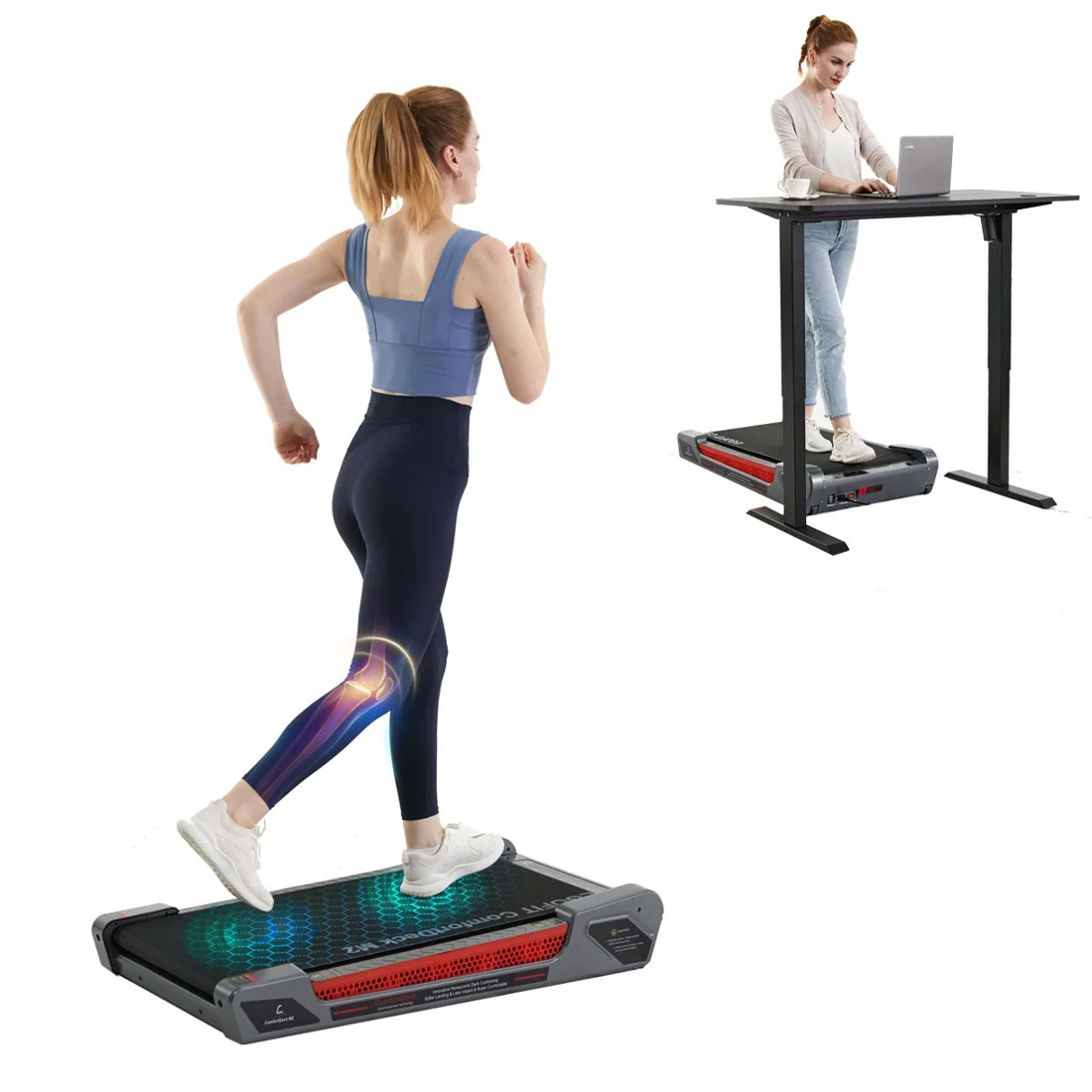
Explore this need in the finder →The Egofit ComfortDeck M2 is a short, rail-free desk treadmill with a fixed 3% incline and a wider belt than the earlier M1. Its Honeycomb cushioning is a documented construction feature, but this review does not turn the manufacturer's comfort language into a measured result. Choose the M2 for its physical arrangement, speed and capacity fit.
A different deck from the M1
Egofit's current US technical table specifies a 36.2 by 17.7 inch walking area, compared with the M1's 34.25 by 16.54 inches. The additional width is a concrete difference for someone comparing these short machines. It still does not create the length of a roughly 47 inch WalkingPad belt. Consider both dimensions when deciding which compromise suits the room.
The M2's published overall size is 41.5 by 22.8 by 7 inches. That is a compact open footprint, rather than a long deck that becomes compact only after folding. A buyer who can leave the machine near the desk may value that simplicity. Someone whose only available storage is a short compartment should also compare the actual folded length of a half-fold model.
Cushioning deserves a careful interpretation
The M2 uses the manufacturer's Honeycomb ComfortDeck arrangement. That describes its design and helps distinguish it from the M1. It does not tell us how firm it will feel under your steps, how much sound will reach the room below or whether it will help a painful condition. We have not performed those tests, and a product photograph cannot supply them.
If cushioning feel is a deciding factor, look closely at the seller's current return terms and the practical work of returning a heavy machine. That is more useful than selecting a model on an unqualified “joint-friendly” promise. A treadmill remains an active walking surface with maintenance and setup requirements.
The slope is fixed at 3%
The M2's 3% incline is built in. It is a different slope from the M1's 5%, not an adjustable setting that cycles between the two. This distinction matters for a desk user who wants the option to return to level. The M2 does not meet that need. It is better suited to a buyer who deliberately accepts a permanent mild slope.
The documented speed range is 0.62–3.1 mph. A slow starting pace may help you learn the machine's operation, while its upper limit may exclude someone who wants brisk 4 mph walking. A lower slope and a higher motor label do not justify inventing a faster operating range than the manufacturer states.
Resolve the load wording conservatively
Both the official page and manual print “110 kg / 245 lb.” Those are not exact equivalents. For a purchase near the boundary, ask the manufacturer to confirm the limit for the actual unit. The finder uses a conservative 242 lb ceiling, below the 110 kg equivalent, rather than silently treating the larger printed pound figure as extra capacity.
This discrepancy does not change the basic comparison with the 220 lb M1, but it does matter for someone near the M2 limit. If your requirement is 250 lb, neither printed form supports a match. The current 300 lb A1 Pro or an appropriately selected R3 is a more relevant capacity direction to investigate.
Consider the whole moving and working routine
The stated net weight is 51.36 lb. Wheels assist movement, but moving it to another floor or around a tight corner is still a handling job. Measure desk braces and verify that the desktop can rise to a comfortable position after the walking surface raises your standing height. Keep controls accessible and test the start and stop sequence before adding work.
The official manual includes belt lubrication at three months or 50 hours, whichever comes first. Leave room for that care as well as normal walking. If you want a folding handrail, the M2T adds that capability and changes width and weight. If you need a level surface or a much longer belt, the rail-free M2's compactness is the wrong reason to overlook those needs. This assessment is based on the published US configuration.
Sources: Egofit M2 product specifications; official M2/M2T manual.
Key details at a glance
| Walking deck folds | No |
|---|---|
| Handrail supplied | No |
| Load configuration | Conservative 242 lb ceiling; official wording also prints 110 kg. |
| Usable belt length | 36.2 in |
| Usable belt width | 17.7 in |
| Stated machine weight | 51.36 lb |
| Walking speed arrangement | 0.62–3.1 mph conservative walking reference |
| Incline mechanism | 3% fixed |
| Storage routine | Nonfolding walking deck; handrail may fold separately. |
Use the exact model’s instructions for operating limits, supplied equipment and version differences.
Sources for this assessment
Find a walking pad for your real workspace.
Start with the load allowance, usable belt and storage routine, then add essential controls.