
Your needs, this model
Does it fit your priorities?
Can the selected version meet a 280 lb requirement?
Yes, only when the actual US unit is the selected 300 lb configuration.
Explore this need in the finder →Can it start slowly for desk walking?
Yes. The current table starts at 0.5 mph.
Explore this need in the finder →Does the folded deck fit a 5 inch height limit?
The published folded height is 5 inches; leave practical clearance.
Explore this need in the finder →The current US WalkingPad A1 Pro is worth examining when a 220 lb walking pad is insufficient. Its selected 300 lb version combines a half-fold deck with a wider walking area than the C2. The reason to consider it is that specific capacity and fit, rather than an assumption that every A1 Pro sold in every country is the same machine.
Check the 300 lb configuration first
The current US page's purchase selection states a 300 lb maximum load. Its technical table also mentions a 230 lb option. Those figures are not interchangeable. This review and the matching facts cover the selected 300 lb US configuration; a seller offering a different capacity needs its own label and documentation. A familiar A1 Pro name on a marketplace listing is not enough to carry the higher limit across.
That distinction matters most to the buyer this model seems designed to serve. If you need more than 220 lb capacity, the C2 or P1 is not an alternative simply because it folds similarly. Check the exact unit's permitted load before using it and include anything you intend to carry while walking. A capacity is a limit, not a promise about comfort, durability under every routine or suitability for a particular person.
More belt width, with a substantial machine to move
WalkingPad lists a 47 by 16.5 inch walking area. That offers more side-to-side space than the C2's 15.7 inch belt, although it remains a compact walking deck. Mark out the belt dimensions on the floor to understand the scale, then separately measure the body footprint. The frame around the belt consumes desk space without adding space for your stride.
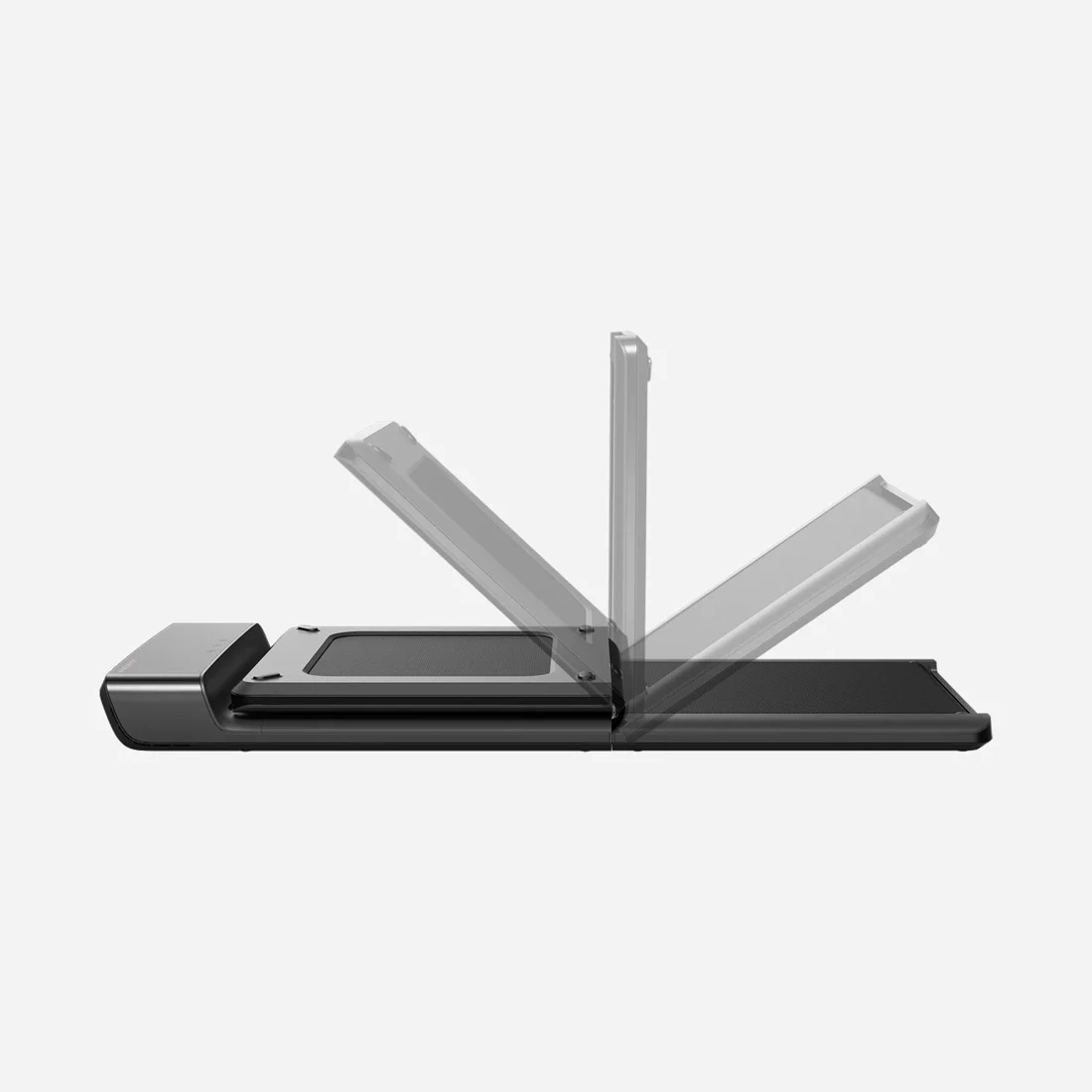
The listed net weight is 63 lb. Its wheels can assist with moving the treadmill, but anyone who expects to lift it daily should take that weight seriously. The deck's fold makes it shorter to store; it does not turn the unit into a lightweight accessory. A permanent place near the desk may make more sense than a storage location across a threshold or upstairs.
Slow walking is a meaningful difference
The manufacturer's technical table gives a 0.5–3.75 mph range, while a selection label rounds the upper figure to 3.7 mph. The useful point for desk work is the low starting speed. A half-mile-per-hour minimum gives a different starting option from the C2's current 1 mph specification. That does not establish which pace will work for your typing, but it is a concrete reason to compare the models.
Keep the task modest at first. Getting used to starting, stopping and staying centered deserves your attention before you try to write a detailed email while moving. The A1 Pro is a walking machine. Some manufacturer image descriptions use the word “running,” but that does not create a separate supported running configuration in this assessment.
Storage dimensions and control choices
The folded dimensions are 32.5 by 21.5 by 5 inches. Check all three dimensions against the furniture opening and the floor space beyond it. A low bed frame can have a central support or a storage box that blocks the route even when the front opening is tall enough. Leave space to unfold the deck without trapping cables or blocking your chair.
Control options include a remote, the KS Fit app and FootSense, which changes speed in response to the user's belt position. That automatic method is an option to learn, not proof of effortless multitasking. Think about whether you want position changes to affect pace while you reach for a mouse or look at another screen. Follow the supplied instructions for your actual unit and keep its stop control accessible.
Who should compare something else?
If your required capacity exceeds 300 lb, the A1 Pro's main advantage is still insufficient. The R3 walking model offers a different documented capacity to investigate. If your need is a very short open footprint, an Egofit model may suit the room better, with a shorter belt and a fixed slope to evaluate. If your priority is easy lifting, compare actual unit weights before focusing on folded size.
The A1 Pro's case is therefore specific: a low starting speed, 16.5 inch belt and the selected 300 lb capacity in a folding walking machine. It is a useful combination when all three fit the household. Its weight and exact-version requirement belong in the purchase decision from the beginning.
Source: WalkingPad A1 Pro US product page, selected load and technical table. This assessment uses published documentation; we have not tested walking feel, noise or long-term reliability.
Key details at a glance
| Walking deck folds | Yes |
|---|---|
| Handrail supplied | No |
| Load configuration | Selected US 300 lb configuration only. |
| Usable belt length | 47 in |
| Usable belt width | 16.5 in |
| Stated machine weight | 63 lb |
| Confirmed folded length | 32.5 in |
| Confirmed folded width | 21.5 in |
| Confirmed folded height | 5 in |
| Walking speed arrangement | 0.5–3.7 mph conservative walking reference |
| Incline mechanism | No incline mechanism claimed in this assessment |
| Storage routine | Half-fold deck; measure the machine and its access route. |
Use the exact model’s instructions for operating limits, supplied equipment and version differences.
Sources for this assessment
Find a walking pad for your real workspace.
Start with the load allowance, usable belt and storage routine, then add essential controls.