
Your needs, this model
Does it fit your priorities?
Can I start below 0.7 mph?
Yes. The current technical table starts at 0.3 mph.
Explore this need in the finder →Can the long belt fold within a 5 inch height?
Yes, using the current 5 inch folded height.
Explore this need in the finder →Does it accept a 240 lb user load?
No. The documented ceiling is 220 lb.
Explore this need in the finder →The WalkingPad P1 puts an unusually important part of the treadmill in your hand: the workout display is on its remote. That arrangement, a low published starting speed and a 16.5 inch walking belt make it a distinct option among WalkingPad's folding machines. Its 220 lb capacity and 62 lb stated machine weight are equally important parts of the decision.
A simple-looking machine with a specific control arrangement
The P1's technical table specifies a remote display and no panel display on the treadmill body. For someone who finds a floor-level readout awkward beneath a desk, a remote display can be useful. It also makes looking after that remote a daily requirement. Plan somewhere secure and reachable for it, and check replacement availability if losing small controls is a recurring household problem.
The product page lists FootSense position-responsive control as well as the KS Fit app. That offers another way to manage pace, but it does not make the remote irrelevant. Learning how the machine responds deserves a separate session before combining walking with office work. Reaching forward for a keyboard and deliberately moving forward to change pace should not be confused.
Pay attention to the current speed specification
WalkingPad's current technical table gives 0.3–3.75 mph, equivalent to the listed 0.5–6 km/h. Some selection labels round the P1 differently. This review uses the technical table for the current US reference; the label and instructions on a seller's actual unit still need to agree. A lower starting pace can be useful for settling into a desk routine, without establishing which speed will feel comfortable to you.
The P1 remains a walking machine. A low minimum and a brisk upper walking speed do not support treating it as a compact running treadmill. If you need a second running mode, begin with an actual dual-mode product and verify its rail and safety arrangements. Do not extend the P1's scope because a general collection description happens to mention jogging.
Wide enough for your stride, narrow enough for the desk?
The documented walking area is 47 by 16.5 inches. Compare that usable area with the 21.5 inch overall width. The belt gives your feet room; the body determines whether the machine fits between the desk legs. Both measurements matter, and neither can stand in for the other. Mark the open footprint on the floor and check braces, drawers and cords before planning where the chair will go.
The maximum stated user weight is 220 lb. Buyers who need a higher limit should move directly to a different documented configuration. The related A1 Pro selected 300 lb version has a similar storage concept but a different capacity. A shared brand, app or overall appearance does not transfer that rating to the P1.
Folding helps storage length, but handling remains substantial
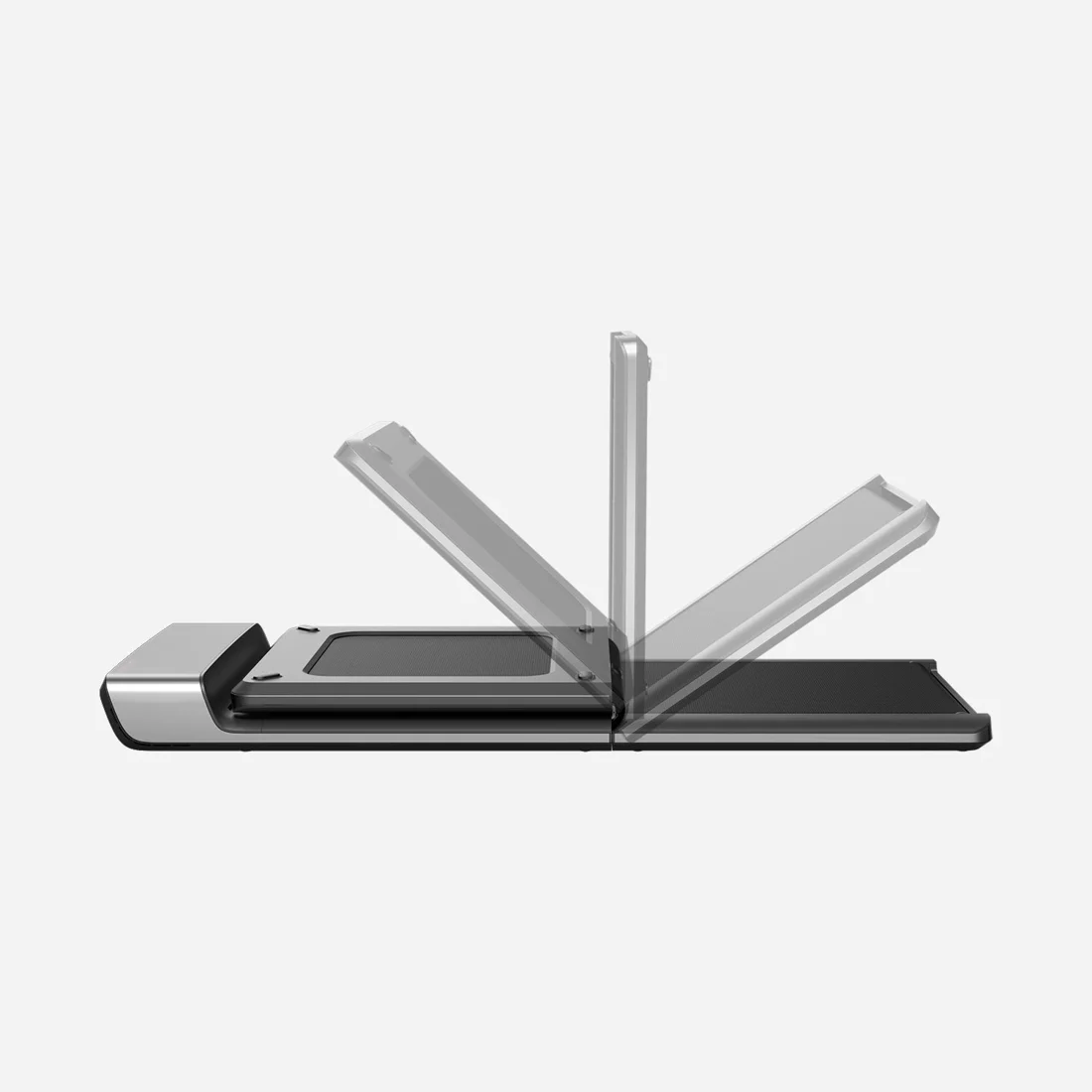
The current dimensions are 56.5 by 21.5 by 5 inches open and 32.5 by 21.5 by 5 inches folded. A half-fold deck can make the P1 easier to put beneath furniture after work. Measure past the entry opening as well: an internal support can prevent the machine sliding fully inside. Leave enough clear room to unfold it and to walk around it when returning to a chair.
The listed net weight is 62 lb. It is not the lightest option here, despite the restrained appearance. Transport wheels can assist on level flooring, while steps and lifting tasks remain your responsibility. If carrying weight matters more than the long belt, compare the WalkingCase with particular care over its unresolved dimension discrepancy, or a shorter nonfolding Egofit machine.
Silver and pink belong to the same operating assessment
The P1 and separately listed Pink P1 pages publish matching operating dimensions, capacity, motor type and speed table, and the main P1 page lists both finishes. They are assessed together here as finish choices, without counting pink as a separate walking capability. A color's availability can change independently, so check the actual unit and package when ordering.
The P1's most convincing use is slow walking with a remote readout and a long folding deck. The C2 offers a different minimum pace, narrower belt and lighter listed unit. The A1 Pro offers a higher selected load. Those differences are more useful than treating one as a universal upgrade. This review is based on manufacturer documentation, without measured noise, stride or endurance testing.
Sources: P1 US specifications; Pink P1 US specifications.
Key details at a glance
| Walking deck folds | Yes |
|---|---|
| Handrail supplied | No |
| Load configuration | 220 lb stated maximum |
| Usable belt length | 47 in |
| Usable belt width | 16.5 in |
| Stated machine weight | 62 lb |
| Confirmed folded length | 32.5 in |
| Confirmed folded width | 21.5 in |
| Confirmed folded height | 5 in |
| Walking speed arrangement | 0.3–3.7 mph conservative walking reference |
| Incline mechanism | No incline mechanism claimed in this assessment |
| Storage routine | Half-fold deck; measure the machine and its access route. |
Use the exact model’s instructions for operating limits, supplied equipment and version differences.
Sources for this assessment
Find a walking pad for your real workspace.
Start with the load allowance, usable belt and storage routine, then add essential controls.