
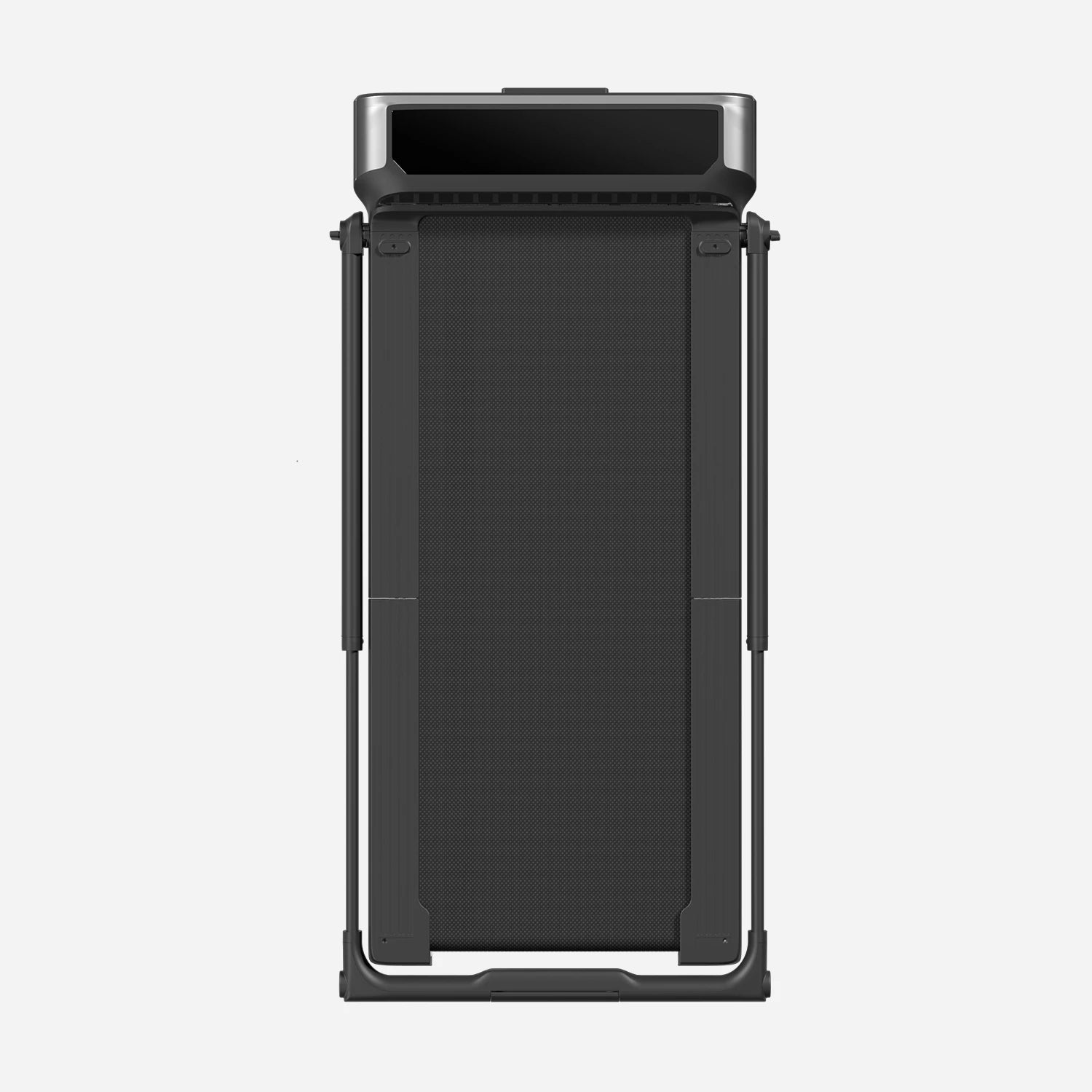
Your needs, this model
Does it fit your priorities?
Can it support desk walking at a 265 lb load with an app and a 17 inch minimum belt?
The exact U.S. listing gives a 265 lb limit, a 47.2 by 17.3 inch belt and KS Fit app control. The separate manual-dependent desk clearance still needs confirmation.
Explore this need in the finder →Can it fit a 58 by 30 inch open footprint and fold below an 8 inch height limit?
The manufacturer lists 57.8 by 29.9 inches unfolded and 40.3 by 29.9 by 7.7 inches folded; measure your room and allow clearance beyond the listed body dimensions.
Explore this need in the finder →Does the rail-up mode meet a 7.5 mph ceiling, a 265 lb limit and a remote-control preference?
Yes, the product page lists one 1–7.5 mph range, 265 lb capacity and an included remote. Those are manufacturer specifications, not a personal performance test.
Explore this need in the finder →Will it meet an essential 0.7 mph-or-slower starting speed?
No. Its listed minimum is 1 mph, so it should not be shortlisted for a 0.7 mph-or-slower start requirement.
Explore this need in the finder →The WalkingPad R3 Hybrid is the more useful R3 for someone who wants one machine to move between walking under a desk and a faster, handrail-up workout. It is not simply the 265 lb choice of the regular R3 listing: WalkingPad’s U.S. product record identifies a separate model and SKU, US-WP-R3-HYBRID. That matters because the Hybrid is rated to 265 lb, reaches a listed 7.5 mph, and has an adjustable handrail; the R3 walking model is a lower-speed desk machine with separate 265 lb and 330 lb selections.
What the exact model page establishes
The U.S. listing gives a 47.2 by 17.3 inch running area, a 1–7.5 mph range, a 265 lb user limit, and an 84.9 lb net weight. It lists the folded body at 40.3 by 29.9 by 7.7 inches and the unfolded unit at 57.8 by 29.9 by 32.9 inches. The listed supply is 110 V. The page describes a 3 HP brushless motor, SoftStep cushioning, an LED display and light bar, a flip-up phone holder, adjustable handrail, remote, KS Fit app and FootSense position-responsive speed adjustment. These are manufacturer specifications and feature descriptions, not measurements made for this review.
Why choose this hybrid
The meaningful advantage is the second posture. The exact page describes lowered-rail desk walking and a raised-rail mode for jogging or running, so it can bridge a workday walking routine and a separate workout without buying two machines. Its 17.3 inch belt is wider than the A1 Pro’s listed 16.5 inches and the basic walking R3 shares the same 17.3 inch area. The Hybrid’s 7.5 mph ceiling is also far above those two walking-oriented alternatives. It is a sensible candidate if that range and a 265 lb capacity meet the need and you want a supplied rail available for the faster mode.
WalkingPad advertises noise below 65 dB. That is the manufacturer’s claim, not an independent acoustic measurement, and it cannot predict sound through a particular floor or during another person’s calls. The company also names SoftStep cushioning, but there is no test here of impact, comfort, joint protection or long-term durability. Choose by the published dimensions and controls, not by those promotional phrases alone.
What changes when you set requirements
For desk walking, the finder can match its documented desk mode, 265 lb limit, app, remote or FootSense control, and the 47.2 by 17.3 inch belt. It will not satisfy the optional slow-start requirement: the model page starts at 1 mph, above the finder’s 0.7 mph threshold. A request for the full 7.5 mph range is a rail-up workout need; the page does not publish a separate maximum for lowered-rail desk walking, so that speed is not carried into the desk plan. At 266 lb, the Hybrid fails even though another R3 load selection can be rated higher.
It folds, but folded storage is not the same thing as clearance beneath a standing desk. Its listed 7.7 inch height is the folded storage profile; the lowered-rail operating height is not supplied. Nor does the public page establish a vertical-storage allowance, an uninterrupted-session limit, or a recommended number of daily hours. The exact product page lists a user manual in the box but does not link a downloadable guide. Ask for the manual associated with SKU US-WP-R3-HYBRID before relying on setup, locking, desk clearance, lubrication or duty instructions. Do not substitute instructions for the separately named R3 Hybrid+.
Room, controls and the package
At 84.9 lb net, it is a substantial machine to move by lifting; its built-in wheels may help reposition it on a suitable floor, but no handling-force test is available. The full width is 29.9 inches, and the open length is 57.8 inches, so measure doorways, the intended desk opening and the working area rather than assuming the “compact” label resolves fit. The listed package includes a safety key, power cord, remote, wristband, wrench and printed user manual. The page says the KS Fit app can connect with an Apple Watch; it does not list a watch as included. The remote and app offer familiar direct control, while FootSense adjusts speed by the user’s position. People who want a fixed button-selected pace may prefer a simpler walking model.
Alternatives and limits
The regular WalkingPad R3 is the more desk-first choice if 1–4 mph is enough and the higher 330 lb capacity selection matters; its wider 26.5 inch footprint is a separate tradeoff. The A1 Pro 300 is a more compact, slower-start option: 0.5–3.7 mph, 300 lb capacity, a 16.5 inch belt and a 5 inch folded height in the reviewed 300 lb configuration. Neither alternative should inherit the Hybrid’s 7.5 mph range or adjustable rail. Conversely, the Hybrid does not inherit the R3’s 330 lb selection or the A1 Pro’s 0.5 mph start.
At the time checked, WalkingPad’s U.S. product page marked this exact SKU sold out. That is not the same as discontinued, but it also is not a promise of restock. If the model returns, confirm the exact SKU, manual and seller package before ordering. This review is based on primary manufacturer material, not hands-on ownership or a treadmill test.
Key details at a glance
| Walking deck folds | Yes |
|---|---|
| Handrail supplied | Yes |
| Load configuration | The exact U.S. product page lists a 265 lb maximum user weight. Do not borrow the higher allowance from the separate R3 walking model or another version. |
| Usable belt length | 47.2 in |
| Usable belt width | 17.3 in |
| Stated machine weight | 84.9 lb |
| Confirmed folded length | 40.3 in |
| Confirmed folded width | 29.9 in |
| Confirmed folded height | 7.7 in |
| Walking speed arrangement | The exact U.S. product page gives one 1–7.5 mph model range. Its desk mode is described as walking and the raised-rail mode as running; the page does not publish separate mode-specific speed ceilings. The desk-plan max_mph is held unknown. |
| Storage routine | The exact U.S. page gives 40.3 × 29.9 × 7.7 in folded and 57.8 × 29.9 × 32.9 in unfolded. A vertical-storage permission or exact desk-mode height is not established. |
| Activity watch included | No |
Use the exact model’s instructions for operating limits, supplied equipment and version differences.
Sources for this assessment
Find a walking pad for your real workspace.
Start with the load allowance, usable belt and storage routine, then add essential controls.