
Your needs, this model
Does it fit your priorities?
Can a 300-pound requirement coexist with power incline?
The linked US guide gives a 300 lb limit, below the 400 lb sales-page figure; use the lower manual allowance.
Explore this need in the finder →Can it fit a 21-inch-wide operating allowance?
The published outer body width is 20.3 inches, before separate surrounding clearance.
Explore this need in the finder →Can I start slowly using the supplied remote?
The supplied remote controls a walking range beginning at 0.6 mph.
Explore this need in the finder →UREVO SpaceWalk 5L: power incline with a clear flat-storage and session-length routine
The SpaceWalk 5L combines automatic incline with a relatively narrow overall body. Its current sales page advertises 400 pounds, but the linked US URTM054 guide states a 300-pound/136 kg maximum. This review uses the lower manual limit for load matching. Its ownership instructions matter too: UREVO recommends flat storage and sessions no longer than an hour. Resolve the version discrepancy before relying on a higher allowance.
A compact body still needs walking room
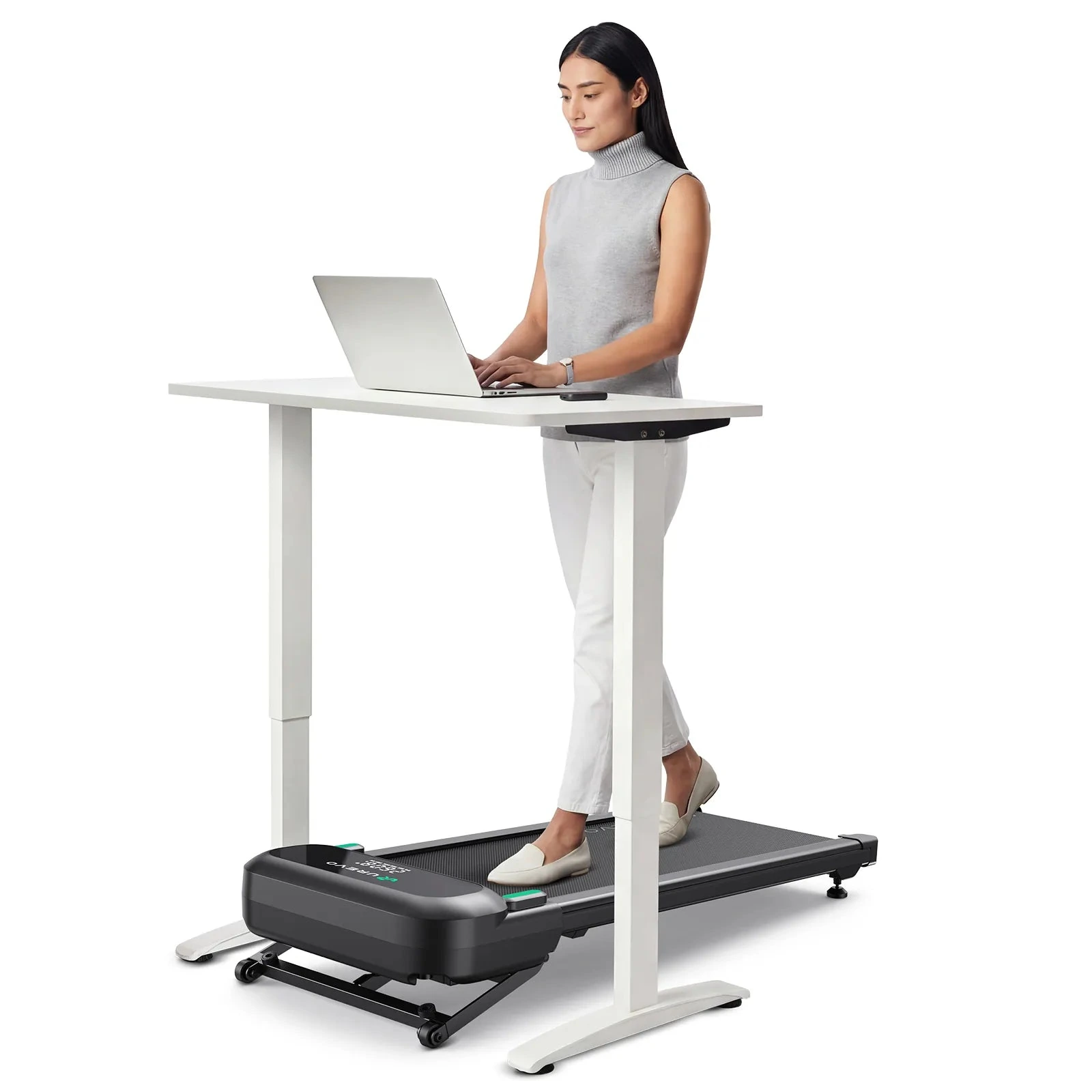
The body measures 48.8 by 20.3 inches, with a listed height of 6.1 inches. The walking area is 39.4 by 15.8 inches. That puts a useful distinction in front of a buyer: the relatively narrow outer width helps with desk fit, but the belt must separately accommodate your feet and stride. Do not use the outside width as a measurement of the walking surface.
Place the pad where you can enter, stop and leave it without squeezing around furniture. A desk's crossbar or cable tray can obstruct a setup even when the legs are far enough apart. Check the added standing height and available desktop adjustment, including the position you would use on an incline. A comfortable flat setup does not automatically remain comfortable when the front of the walking surface rises.
Separate work walking from incline workouts
The 5L has a stated 0.6–4.0 mph range and nine automatic incline levels across a 0–9% range. A flatter or lower setting can suit a concentration-heavy task; a steeper setting is more sensibly explored during a separate walking break. The useful benefit of power adjustment is being able to change the walking angle without manually repositioning support feet, rather than a reason to keep the machine at its steepest setting.
The official page describes compatible app sessions that can adjust speed and incline. Learn those functions while you can give walking your full attention. If you want a steady desk pace, choose a routine that remains predictable instead of assuming every connected workout holds speed constant. A route-based training feature and an uninterrupted typing session are different uses of the same machine.
Take the one-hour guidance seriously
UREVO's current FAQ recommends sessions no longer than one hour, with periodic motor rest. That is a material distinction for someone planning several consecutive hours of workday walking. A daily total of several shorter sessions is not the same demand as one uninterrupted stretch. If continuous shared-office use is essential, compare an explicitly documented duty recommendation on a suitable LifeSpan model rather than borrowing the 5L's load rating as evidence of all-day operation.
The page also advises against direct use on carpet because fibres can obstruct ventilation. Choose an appropriate level location and follow the specified mat guidance. A mat does not make every soft floor or unstable surface suitable. Keep the underside's airflow path clear and stop to investigate unusual heat or noise instead of using a stronger setting to compensate for a problem.
Storage is flat, not upright
The current manufacturer answer explicitly discourages vertical storage. Measure a suitable flat space and its approach route before buying. The 6.1-inch height needs additional practical clearance under furniture, and the full body must slide in without catching a brace or fabric panel. Its published 50.7-pound weight also matters if that route includes lifting rather than simply using the transport wheels.
A remote is included; the handrail shown among optional accessories is a separate purchase. Keep that distinction clear when comparing package photographs. The UREVO App can track activity and compatible training information, while routine belt inspection, lubrication and alignment remain ownership tasks. Choose the 5L when the lower documented 300-pound allowance, narrower body and power incline fit manageable sessions, and you have a flat storage plan matching its instructions.
Compare the 3S for more belt area within a lower load allowance. If the priority is a documented daily-use recommendation and a wider surface, the LifeSpan TR1200Pro deserves consideration, with a larger footprint and heavier body.
Key details at a glance
| Handrail supplied | No |
|---|---|
| Load configuration | Sales page advertises 400 lb; linked US URTM054 guide states 300 lb. Lower manual limit governs essential load matching. |
| Usable belt length | 39.4 in |
| Usable belt width | 15.8 in |
| Stated machine weight | 50.7 lb |
| Walking speed arrangement | 0.6–4.0 mph published walking range |
| Incline mechanism | 0–9% automatic incline, nine levels |
| Storage routine | Measure the full body and use only manufacturer-approved storage orientation. |
Use the exact model’s instructions for operating limits, supplied equipment and version differences.
Sources for this assessment
Find a walking pad for your real workspace.
Start with the load allowance, usable belt and storage routine, then add essential controls.