
Your needs, this model
Does it fit your priorities?
Can a 242-pound slow desk-walking requirement use manual incline?
The US guide states 242 lb and documents support-leg incline; the higher sales-page figure is unresolved.
Explore this need in the finder →Can it fit a 43 by 20-inch operating allowance?
The body measures 42.9 by 19.3 inches, before separate clearance.
Explore this need in the finder →Can it stay below 36 pounds?
The published machine weight is 35.5 pounds.
Explore this need in the finder →UREVO SpaceWalk E1L Pro: compact manual incline with conflicting load documentation
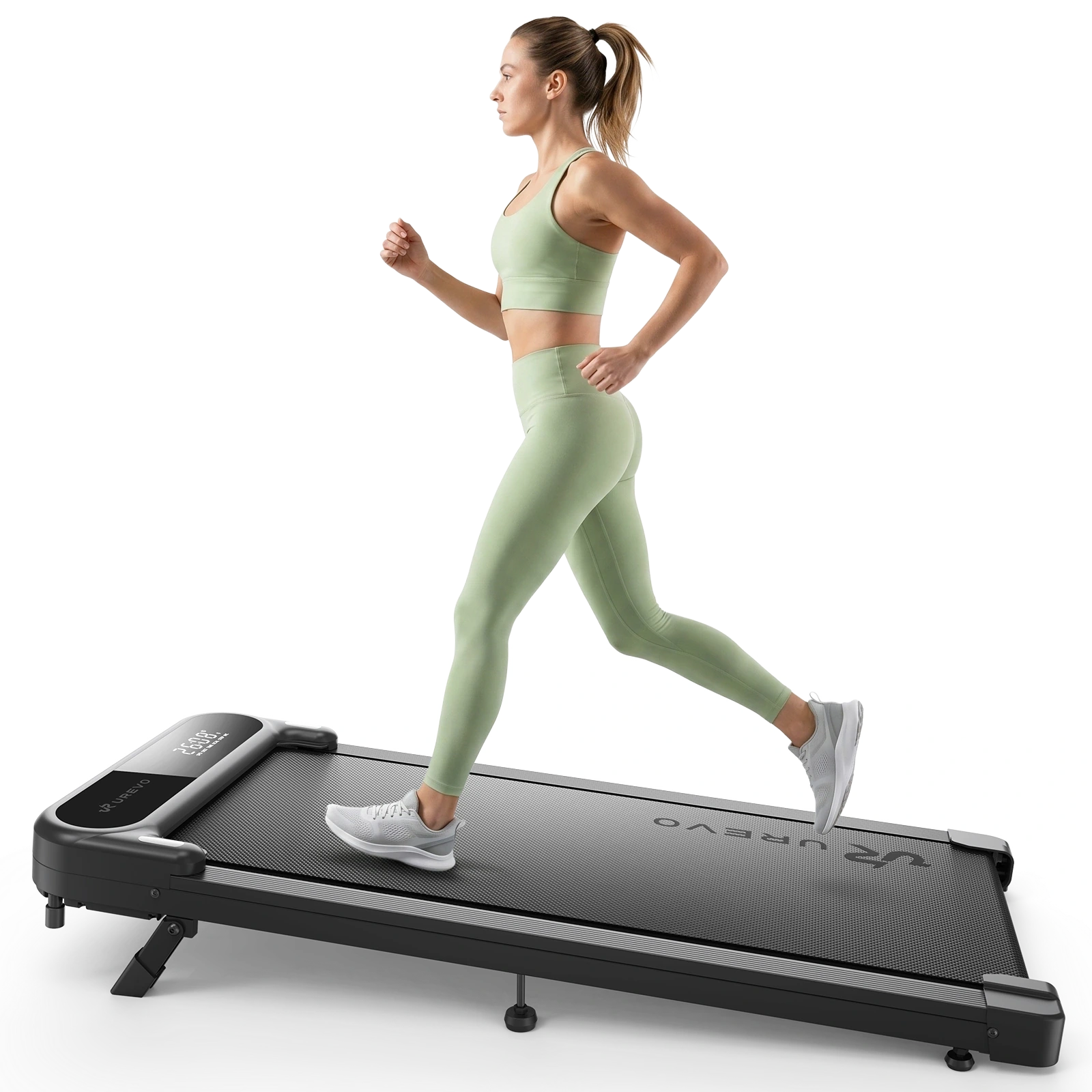
The E1L Pro has a different proposition from the flat E1L: a slightly larger walking area and manually deployed incline within a compact body. Its current US sales table publishes a 350-pound maximum load, but the linked US URTM060 guide states 242 pounds/110 kg. This review uses the lower manual limit for a load requirement. Buyers needing more must obtain exact version-specific clarification before relying on the higher figure.
Start with the exact physical table
UREVO lists the body at 42.9 by 19.3 inches, with a 4.5-inch height. Its walking area is 36.2 by 15.2 inches. That gives a little more belt length and width than the flat E1L, while retaining the same published outer width. The difference is worth measuring carefully rather than assuming that a higher-capacity model must occupy a much larger room.
Both dimensions still describe a compact walking format. Check your ordinary stride and where you naturally place your feet, ideally by trying a similar-size walking surface. The ability to fit a pad under a desk does not prove that the belt fits a person's movement. Keep enough room for entry, stopping and stepping off; do not use the desk as a substitute support rail.
A sales-page rating does not override the manual
The webpage and linked guide disagree about permitted load. A revised machine or outdated download could explain that difference, but neither explanation is established. Do not use a 350-pound allowance for the documented 242-pound guide configuration. The page's 35.5-pound machine weight is a separate measurement; neither low machine weight nor a load rating tells you how wide the belt feels or how long a continuous session is permitted.
Trace the storage route before choosing it for portability. Wheels can help on an appropriate continuous floor, while a stair, tall threshold or crowded doorway can require a more awkward movement. Protect the cord and leave somewhere to place the machine safely when it is out of use. A small listed height is useful only if your furniture has enough real clearance beneath it.
Do not confuse automatic speed with power incline
The published speed range is 0.6–4.0 mph. The page describes app-driven speed functions and separately lists a 12% incline. The linked guide resolves the mechanism: lock the front support legs and install the central support foot for incline. Retract the supports as instructed to return to flat operation. The central support must be installed and locked again before incline use. Stop and follow the setup instructions rather than treating this as remote-adjustable elevation.
This distinction affects an ordinary purchase decision. If you specifically want power-adjustable incline, look for an explicitly documented automatic mechanism, such as the 3S or 5L arrangement. If you want an unambiguously flat walking surface, the regular E1L has that explicit manufacturer statement. A connected app can control one part of a workout without establishing how another physical mechanism operates.
Build the desk routine gradually
The supplied remote gives a direct control route, and the UREVO App supports compatible tracking and training functions. Begin with walking itself, then add a simple work task once you know how the chosen setting feels. A changing-speed workout deserves your attention separately from detailed typing. Keep the remote reachable without searching around the desktop while the belt is moving.
The current box lists the cord, remote, tools, lubricant and manual. Check the actual retailer package before counting a separately advertised handrail as supplied equipment. Follow the exact belt-care and electrical instructions. The E1L Pro is a candidate when its narrow body and manual incline fit the routine, subject to the lower documented load and clarification of the actual ordered version.
For flat walking without support-leg adjustments, compare the E1L. For more walking area and control-operated elevation, the 3S offers a different tradeoff: a larger, heavier body with power incline.
Key details at a glance
| Handrail supplied | No |
|---|---|
| Load configuration | Sales page advertises 350 lb; linked US URTM060 V2.0 guide states 242 lb. Manual incline and flat return are positively established. |
| Usable belt length | 36.2 in |
| Usable belt width | 15.2 in |
| Stated machine weight | 35.5 lb |
| Walking speed arrangement | 0.6–4.0 mph published walking range |
| Incline mechanism | 12% manually set support legs; central support foot required; flat return documented |
| Storage routine | Exact storage orientation and full body dimensions must be checked. |
Use the exact model’s instructions for operating limits, supplied equipment and version differences.
Sources for this assessment
Find a walking pad for your real workspace.
Start with the load allowance, usable belt and storage routine, then add essential controls.