
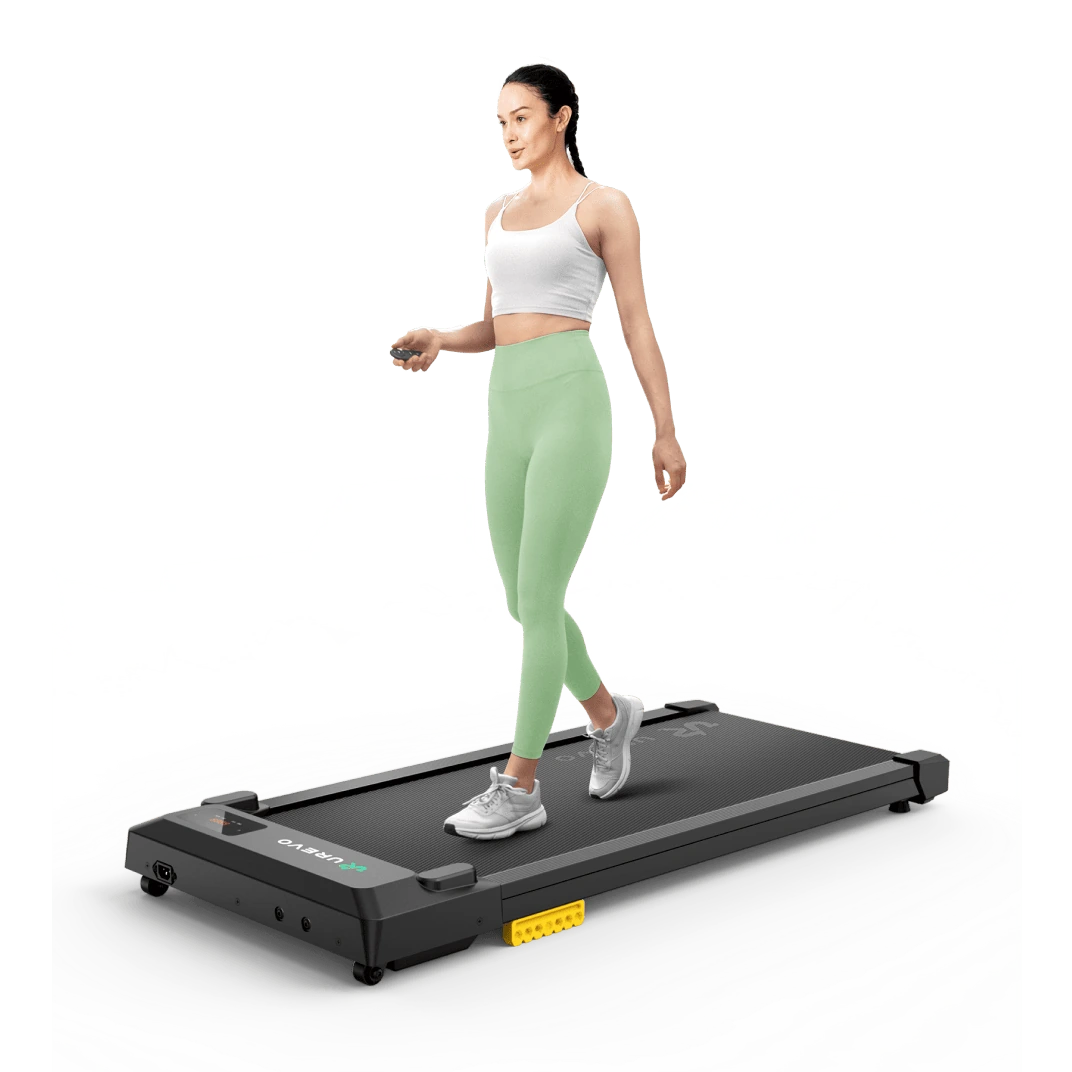
Your needs, this model
Does it fit your priorities?
Can it stay below 40 pounds?
The current exact-model specification lists 36.59 pounds.
Explore this need in the finder →Can it fit a 43-inch-long and 20-inch-wide operating allowance?
The published body is 42.1 by 19.3 inches, before separate surrounding clearance.
Explore this need in the finder →Can it support a 265-pound slow desk walk?
The stated load is 265 pounds and the range starts at 0.6 mph.
Explore this need in the finder →UREVO SpaceWalk E1L: a flat walking pad for a small, frequently used workspace
The SpaceWalk E1L is the straightforward flat model in UREVO's current walking range. Its main attraction is a relatively compact body and a low published weight, rather than a collection of incline settings. For someone who wants to clear the floor after a short desk session, those physical details can be more useful than a larger machine's workout features. The important compromise is its short, narrow walking area: make sure the space you gain in the room does not take away the space you need to walk comfortably.
Measure the person as well as the room
UREVO lists a 42.1 by 19.3-inch body and a 35.43 by 15-inch walking area. Those are different measurements. The body dimensions help you check the desk's leg opening and the place where the machine will stand; the belt dimensions describe the surface available for your feet. A pad that fits between two desk legs can still be an awkward fit for a person's usual stride. If possible, try a similarly sized walking surface before committing to a tight setup.
A short belt rewards a deliberate walking position. Do your first sessions away from detailed computer work, with enough room to step on and off as instructed. Establish a comfortable pace and position before adding a keyboard or a call. Do not use the desk edge as a substitute for a handrail, and do not assume that a separately advertised support accessory is included with the machine.
Flat walking is a meaningful choice
The official specification gives a 0.6–4.0 mph range and a 265-pound maximum load. The manufacturer's current FAQ explicitly describes a flat walking surface without an incline function. That makes the E1L a distinct option for someone who wants a consistent walking angle. It should not be confused with the E1L Pro, whose different capacity and incline specification need their own assessment.
The upper speed is a limit, rather than a target for working at a desk. Reading and typing can call for a much slower setting than a separate walking break. Start with a routine that leaves enough attention for your footing, then judge whether the work task remains comfortable. If a higher incline or an automatic workout is the main attraction, another model is a better starting point than trying to make the E1L serve that purpose.
Plan a real storage route
The published weight is 36.59 pounds and the height is 4.2 inches. Transport wheels help with repositioning on an appropriate floor, but they do not carry the machine over stairs or a high threshold for you. Trace the route to the storage space, including turns, doorways and the point where you must lift an end. A manageable rolling route and a difficult full-body lift can coexist in the same apartment.
Allow extra clearance when checking a bed or sofa opening. The listed height does not account for a sagging fabric underside, a low central brace or space for your hands. Keep the cord protected during movement and place the pad on a suitable firm, level surface for use. Do not assume that being slim authorizes vertical storage or changes the full body length.
Controls and ownership
The supplied remote provides a direct control route, while the UREVO App supports activity information and compatible connected functions. Keep the remote somewhere you can reach without looking down and searching while the belt moves. Explore app features separately before relying on them during work; a connected training feature does not automatically improve a concentration-heavy desk task.
The box includes the remote, cord, adjustment tool, lubricant and manual. Follow its belt-care and electrical instructions. Choose the E1L for flat walking and a comparatively light body when its 15-inch belt and 265-pound allowance fit. Compare the SpaceWalk 3S for a larger walking area and power incline, or the E1L Pro for manual incline after checking its lower linked-manual load limit.
Key details at a glance
| Handrail supplied | No |
|---|---|
| Load configuration | US manual table agrees with the main product dimensions and load. |
| Usable belt length | 35.43 in |
| Usable belt width | 15 in |
| Stated machine weight | 36.59 lb |
| Walking speed arrangement | 0.6–4.0 mph published walking range |
| Incline mechanism | Flat, no incline function |
| Storage routine | Measure the full body and use only manufacturer-approved storage orientation. |
Use the exact model’s instructions for operating limits, supplied equipment and version differences.
Sources for this assessment
Find a walking pad for your real workspace.
Start with the load allowance, usable belt and storage routine, then add essential controls.