
Your needs, this model
Does it fit your priorities?
Can a 265lb desk requirement use a 40-inch belt?
The exact US manual gives 265lb and 40.2 inches of walking length.
Explore this need in the finder →Can an upright handrail arrangement reach 5mph?
The rail-up console arrangement reaches 6.2mph; rail-down walking remains limited to 4mph.
Explore this need in the finder →Can it fit a 52-inch rail-down length allowance?
The stored/rail-down table states 51.2 inches rather than the 48-inch upright length.
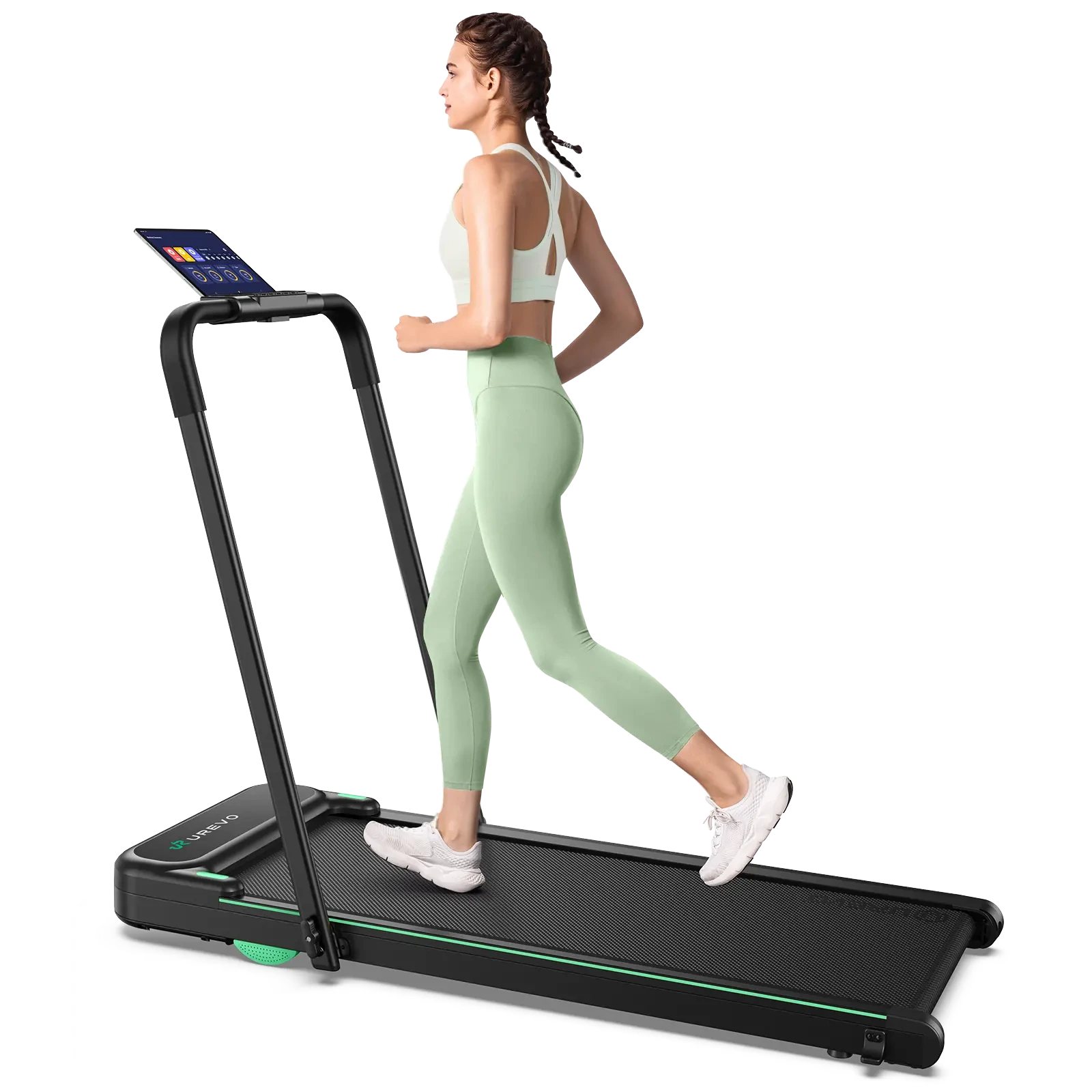
Explore this need in the finder →UREVO Strol 2E: flat walking with a fold-down rail and a longer stored body. The original Strol 2E offers an uncomplicated combination: desk walking with the rail lowered, then faster walking or light jogging with it raised. It omits incline, includes a removable device holder, and requires your own working desk.
The original and Pro make different tradeoffs
The current US specifications give the original Strol 2E a 40.2 by 15-inch running area, 47.2 lb weight and 265 lb maximum load. The Strol 2E Pro is shorter and lighter in its published table, but has a shorter 36.2-inch belt and manually deployed incline. Choosing the Pro therefore does not simply mean getting more of every feature.
The original makes sense when the longer walking surface is useful and you do not need hill walking. Its 15-inch width still deserves careful consideration. A longer belt does not compensate for insufficient side-to-side space, and typing can distract from controlling where each step lands. Compare both dimensions with your actual needs.
Two arrangements, two speed limits
The official FAQ states 0.6–4.0 mph for rail-down desk walking and up to 6.2 mph with the handlebar raised. The manual requires the upright to be securely fixed before running, and shows the safety key in the console arrangement. Follow the setup sequence rather than treating the rail as a loose accessory that can be moved while the belt is running.
The handrail-up exercise speed cannot be borrowed for a low-profile desk setup. Likewise, a remote used for walking is not by itself evidence that every faster console function is available through that remote. Learn the start, pause and stop controls for the configuration you intend to use. Begin with a steady slow pace before adding a work task.
Lower height costs extra length
The upright dimensions are 48 by 22.6 by 38.9 inches. The linked manual lists 51.2 by 22.6 by 4.6 inches with the handrail folded down. The lowered rail therefore saves height while extending the complete body's length by 3.2 inches. That difference matters at the back of a desk opening and under furniture.
This is not a walking deck that folds in half. The manual diagram shows the rail resting over the full-length body. A request for short folded-deck storage should lead to a different design, even if a retailer calls this one foldable. For under-bed storage, measure the complete opening and the route the wheels must follow; a 4.6-inch specification alone does not establish a workable routine.
The flat deck is a deliberate limitation
The manufacturer explicitly states that the Strol 2E has no incline function. That can suit straightforward daily steps and a simple work routine without changing deck height. It also means that a buyer who wants remote-adjustable hills or manually set elevation should consider another model. App content does not add a physical mechanism that the machine lacks.
The supplied holder accepts a compatible viewing device. It does not create a typing desk, and the manufacturer's FAQ says a separate height-adjustable desk is needed for work. Keep the device secure and cables clear of the belt. When the task requires close concentration, slowing or stopping is a more useful response than trying to maintain an arbitrary step target.
Check the actual offer and daily handling
The observed product selection displayed “Sold out,” even though generic surrounding delivery copy said “In stock.” This review therefore does not promise current availability. Confirm the selectable exact model and its supplied components before treating an add-on or Pro option as the original Strol 2E package. A retained product page can remain informative without establishing that stock is available.
At 47.2 lb, the original is lighter than larger workstation treadmills but still a substantial object to carry. Plan a same-floor storage route and keep the power lead out of that path. If the machine must go upstairs after every session, its moving routine deserves as much attention as the motor and top-speed headlines.
The practical shortlist
Consider the Strol 2E for flat desk walking, a supplied exercise handrail and more belt length than the 2E Pro. The Pro adds manual incline with a shorter belt; the 2S Pro adds power incline and a wider surface with a heavier body. For half-length deck storage, compare a folding-deck model such as the WalkingPad C2.
Key details at a glance
| Walking deck folds | No |
|---|---|
| Handrail supplied | Yes |
| Load configuration | 265 lb linked US manual allowance |
| Usable belt length | 40.2 in |
| Usable belt width | 15 in |
| Stated machine weight | 47.2 lb |
| Walking speed arrangement | Work/rail/control limits are distinct operating plans. |
| Incline mechanism | No incline; flat surface |
| Storage routine | Handrail folds; do not infer a walking deck that folds shorter. |
Use the exact model’s instructions for operating limits, supplied equipment and version differences.
Sources for this assessment
Find a walking pad for your real workspace.
Start with the load allowance, usable belt and storage routine, then add essential controls.