
On this page
Your needs, this model
Does it fit your priorities?
Can the W1 Plus handle slow under-desk walking at a 265 lb manufacturer-stated limit?
The exact U.S. page describes under-desk walking, a 0.6–4.0 mph range and a 265 lb user limit. Those are manufacturer specifications, not an independent load test.
Explore this need in the finder →Will its 42.9-by-18.9-inch body and 38 lb net weight fit within a 43-by-19-inch, 40 lb limit?
WalkingPad lists 42.9 by 18.9 by 4.2 inches flat and 38 lb net. Leave room for the actual desk, walking stance and safety space.
Explore this need in the finder →Can I use a manual incline if I set the supports before walking?
Yes. WalkingPad says the front supports are set by hand before a walk; the remote and KS FIT app control speed, not incline. The exact grade is not specified.
Explore this need in the finder →The WalkingPad W1 Plus Stride Station is a light, compact desk-walking pad with a manually set incline, a 0.6 mph starting speed and a manufacturer-stated 265 lb limit. Its appeal is practical rather than ambitious: it is narrow enough to consider in a home office, but the short belt and nonfolding collection placement make it a poor match for buyers who need a running deck or documented folded storage.
A small desk-walking plan, not a running treadmill
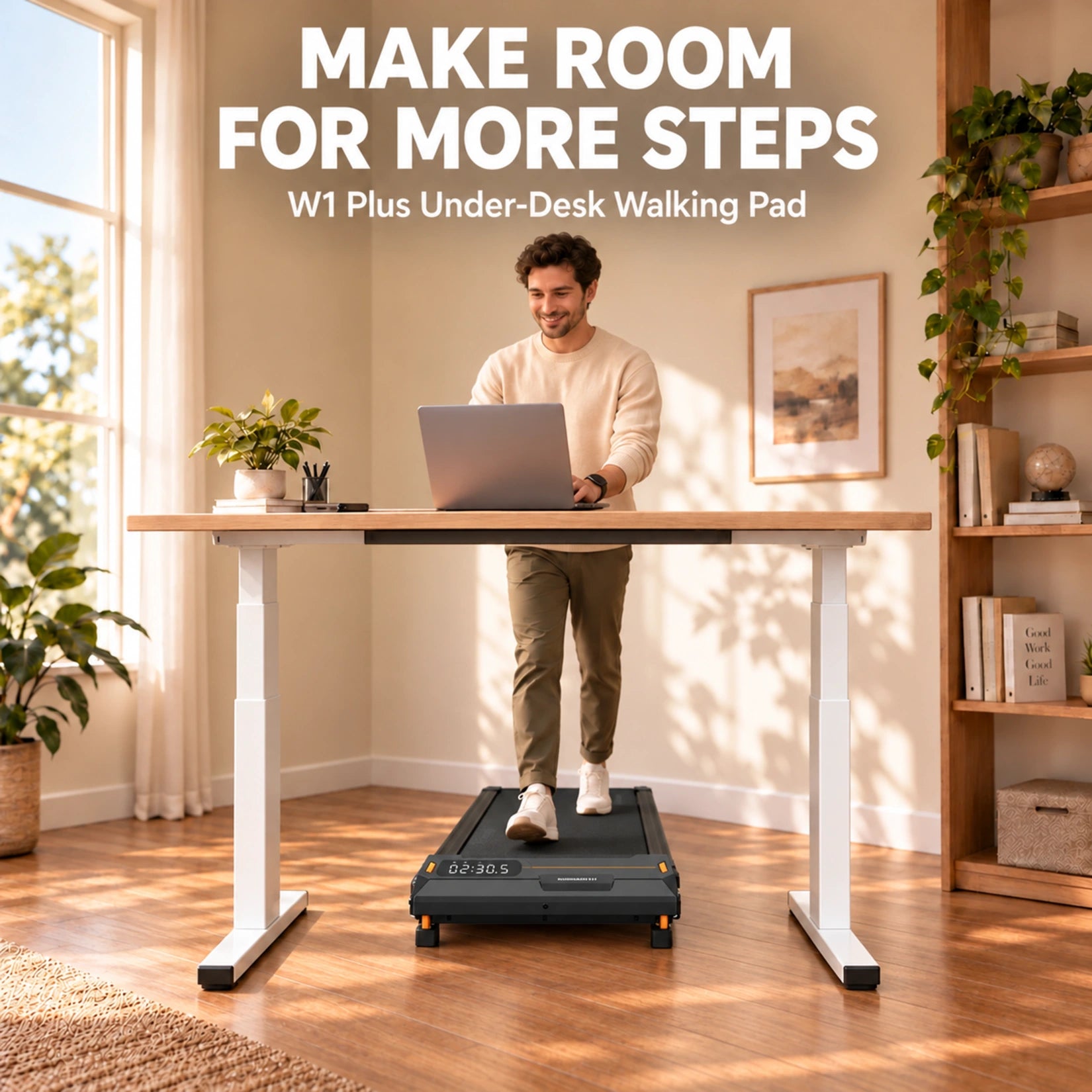
WalkingPad lists the W1 Plus at 42.9 by 18.9 by 4.2 inches in its flat configuration, with a 15-by-36.6-inch walking area and a net weight of 38 lb. The maker shows it beneath a standing desk and describes it for under-desk walking. That is a useful combination for someone who wants to add gentle movement without turning the room into a full cardio corner. The transport wheels should make repositioning easier than carrying a much heavier upright machine, though 38 lb is still a real object to move safely.
The walking surface is the central compromise. A 15-inch belt is a narrower target than the wide decks on full-size treadmills, and 36.6 inches of usable length leaves less front-to-back margin than longer pads. If your gait wanders, you want space for a brisk stride, or you expect to jog, choose a longer and wider machine instead. The listed 4 mph ceiling is a walking pace range, not a promise of running capability.
Incline is something to set before walking
The W1 Plus has a manual incline arrangement: its front supports are set by hand before a session. The remote and KS FIT app change speed; neither adjusts the slope while you are walking. That distinction matters more than the word “incline” on the product page. If you want to switch between grades during a walk, compare a powered-incline model such as the HitGo H1 Plus. The W1 Plus’s exact incline percentage is not stated in the captured U.S. specifications, so it is not the right choice for a buyer who needs a particular grade.
Its 0.6-to-4.0 mph range begins slowly enough for a cautious work pace, and speed can be adjusted by remote or through the KS FIT app. The manufacturer lists Bluetooth FTMS support and a single-window display for time, speed, distance, calories and steps. Treat those as display features, not verified accuracy measurements. The app is optional if you prefer to make basic speed changes without a phone.
Check the actual desk space, not just the height figure
The 4.2-inch body height is a useful starting point when checking an under-desk opening, but it is not a desk-fit guarantee. Leave room for the walking surface, shoes, knees, desk crossbars and cable runs. The product page does not provide a specific desk-clearance dimension or a safety-clearance diagram, so measure your actual arrangement rather than assuming every adjustable desk will clear it. No workstation is identified as part of the W1 Plus product in the captured listing; confirm what is included before treating it as a desk bundle.
WalkingPad places the W1 Plus in its “Non-folding WalkingPad” collection and publishes flat dimensions rather than a folded envelope. I would not choose it when a folding deck or permission to store a treadmill upright is essential. For a documented folding alternative in the same brand, compare the WalkingPad C2; its storage arrangement is a different design, not a reason to assume the W1 Plus folds as well.
What the specification does—and does not—settle
The 265 lb maximum user weight is a manufacturer limit, not an independent load test. The page lists a 0.65 HP brushed motor, 500 W rated power and 100–120 V input. Those are useful identity and compatibility details, but they do not establish sustained motor output, noise, long-session durability or an allowed number of daily operating hours. The current product source also does not state a model-specific session limit, maintenance schedule or exact safety clearance. Follow the supplied instructions for operation and care; do not borrow another WalkingPad model’s manual values or storage procedure.
WalkingPad links a general belt-care guide that says lubrication frequency varies with use and that the owner’s manual should govern model-specific instructions. That is useful background, not a W1 Plus service interval; the product-specific source does not give one.
Buyers who need a larger confirmed weight allowance can compare the WalkingPad A1 Pro 300 lb configuration, which has its own folding design and specification set. That is not automatically the better desk pad: the W1 Plus is lighter and has manual incline, while the A1 Pro is the more relevant reference when 265 lb is not enough. If your must-haves are a very wide belt, powered grade changes, long daily-duty guidance or folding storage, keep looking rather than relaxing those constraints.
Who should shortlist it?
The W1 Plus makes the most sense for a home-office walker who values a low flat profile, a relatively light machine, a slow 0.6 mph start and a manual incline that can be chosen before walking. Its app and remote give two ways to set pace, and the published load ceiling is 265 lb, a manufacturer limit rather than a tested result. It is less suitable for a runner, someone who needs incline changes mid-session, a buyer who needs a verified folded or upright-storage setup, or anyone whose desk opening has not been measured. The product’s compact dimensions are a reason to check fit closely—not a substitute for that check.
Source check: WalkingPad’s exact U.S. W1 Plus product page, its current product/variant record, the maker’s Non-folding WalkingPad collection, and the linked general maintenance and belt-lubrication guides. General care guidance is not a W1 Plus-specific schedule. Specifications are manufacturer statements, not independent performance measurements.
Key details at a glance
| Walking deck folds | No |
|---|---|
| Load configuration | 265 lb maximum user weight stated by the manufacturer; not an independent load test. |
| Usable belt length | 36.6 in |
| Usable belt width | 15 in |
| Stated machine weight | 38 lb |
| Walking speed arrangement | 0.6–4.0 mph stated for the exact U.S. product. |
More specifications and setup details
| Incline mechanism | Front supports are set by hand before walking; speed controls do not change incline. The exact grade is not stated. |
|---|---|
| Storage routine | The manufacturer categorizes the W1 Plus in its Non-folding collection; no folded envelope or vertical-storage permission is established in the captured sources. |
| Documented daily use | The captured exact U.S. product source does not state a recommended daily-hours or continuous-session limit. |
Use the exact model’s instructions for operating limits, supplied equipment and version differences.
Sources for this assessment
- WalkingPad W1 Plus Stride Station exact U.S. product page
- WalkingPad W1 Plus exact U.S. Shopify product and variant record
- WalkingPad Non-folding collection and exact collection-page boundary
- WalkingPad general treadmill maintenance article linked from the W1 Plus page
- WalkingPad general belt lubrication article linked from the W1 Plus page
- Exact-model WalkingPad W1 Plus manufacturer promotional image

Find a walking pad for your real workspace.
Start with the load allowance, usable belt and storage routine, then add essential controls.