
Specifications and versions
When a walking-pad product page and manual disagree
A walking pad can have an attractive sales-page specification and a different limit in the manual linked directly beneath it. Treat that as an unresolved version question. The higher number does not become a safe operating allowance simply because it appears beside the purchase button.
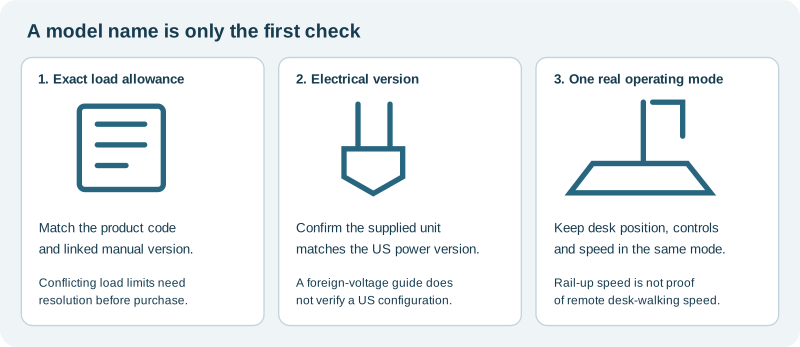
Identify the exact disagreement
Save the model name, market, product code and manual version. Then compare the same measurement. Gross shipping weight is different from machine weight; a motor's peak output is different from a continuous-duty recommendation; and a rail-up speed is different from a desk-walking speed. Those pairs can legitimately have different values. Two different maximum-user-load figures for the same apparent machine need an explanation.
The manufacturer's own download is valuable evidence, but a link does not automatically establish that it covers the current US unit. Check the cover, model code, electrical specification and any version notes. A guide specifying 220–240 V cannot by itself verify the electrical configuration of an ordinary US offering. Keep the unresolved point visible instead of silently choosing whichever source produces the more attractive result.
Three compact incline choices illustrate the decision
UREVO SpaceWalk 5L has a current page advertising 400 lb, while its linked US URTM054 guide states 300 lb. Our essential-load comparison uses the lower manual allowance. Its nine-level power incline can suit someone who wants control-operated elevation changes. It also needs flat storage, and the manufacturer recommends sessions no longer than an hour with motor rest. A load figure does not answer that separate duty question.
SpaceWalk E1L Pro presents a different combination. The webpage advertises 350 lb, but the linked US URTM060 guide states 242 lb. Its incline requires locking the front supports and installing a central support foot. It can return to a flat position through the instructed manual procedure. An app that adjusts speed does not turn those support legs into automatic incline. Its compact body remains useful to compare when that lower documented allowance and manual setup fit.
Strol 2E Pro adds a fold-down handrail. Its current sales table says 300 lb and its linked US URTM059 guide says 265 lb. The lower limit governs our load-dependent comparison. The guide also separates remote control, which accelerates only to 4 mph, from the console needed to reach 6.2 mph. Choosing the rail-up speed and the remote's convenience does not establish that the remote provides that speed.
What a conservative comparison can establish
Using the lower clearly identified US manual limit prevents a comparison from authorizing the higher advertised load. It does not resolve which physical revision a seller will ship. If your requirement falls between the two figures, ask the manufacturer for the exact unit's instructions and rating label before ordering. A vague assurance that a whole product family supports a higher weight does not explain the discrepancy.
If the market or model bridge itself is missing, an unknown value is more appropriate than inventing a safe-looking compromise. CyberPad for Office illustrates that situation: its linked guide gives both a lower load and a different electrical range. We exclude that unresolved US configuration from buying matches while retaining the manufacturer documents as comparison evidence.
Check the operating state as carefully as the number
Fold-down rails can extend a treadmill's complete length. The Strol 2E measures 48 inches upright but 51.2 inches with the rail lowered; the Strol 2S Pro changes from 50.79 to 54.72 inches. Use the lowered configuration for desk fit. A low stored height is also different from a walking deck that folds shorter. Write down the actual arrangement before comparing dimensions.
Once the documentation agrees with the offered unit, keep the manual with the machine and follow its setup, clearance, inspection and maintenance directions. Do not let a retailer's model selector, a promotional photograph or another model's more generous specification fill in an unanswered operating question.