
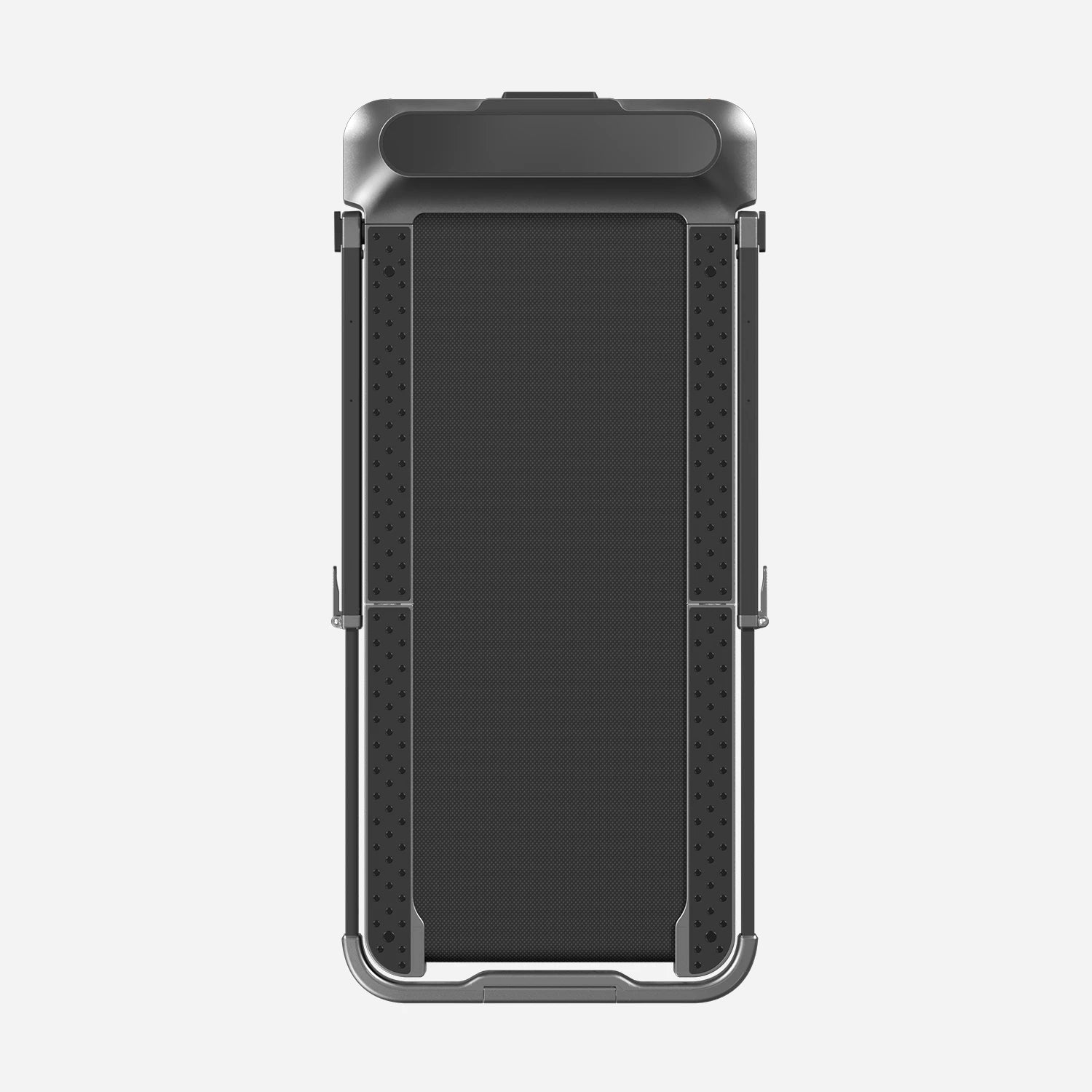
Your needs, this model
Does it fit your priorities?
Can I use the R2 at an existing desk at a 240 lb-or-less allowance with position-responsive control and a 17-inch belt?
The exact U.S. product page describes rail-down desk walking with FootSense and lists a 47 by 17 inch area. Its mode-specific Q&A specifies a 6 km/h (about 3.73 mph) desk maximum. The technical table says 240 lb / 110 kg, while the selector and comparison chart round upward; this assessment keeps a 240 lb ceiling. Desk clearance remains unconfirmed.
Explore this need in the finder →Can its raised-rail plan meet a 7.5 mph upper-speed requirement with a supplied remote and a 240 lb-or-less allowance?
The exact U.S. table lists a raised-rail 7.5 mph upper range and the package includes a remote. This is a separate plan from the 6 km/h (about 3.73 mph) lowered-rail walking maximum. The 240 lb ceiling is conservative because the U.S. capacity labels disagree.
Explore this need in the finder →Will the folded base fit a 39 by 28 inch space with a 6-inch height cap?
The U.S. specifications list a 39 by 28 by 6 inch folded body. The inspected R2 model manual permits upright storage only when supporting points hold both sides and the unit is away from children. Folded dimensions still do not establish desk clearance; the manual also calls for more than 2,000 mm behind and more than 500 mm at each side during operation.
Explore this need in the finder →Will lowered-rail R2 desk walking reach a required 3.8 mph upper-speed capability?
No. The exact U.S. R2 page's mode-specific Q&A specifies a 6 km/h desk maximum (about 3.73 mph), so it meets a 3.7 mph top-speed requirement but not 3.8 mph. The minimum remains unresolved because the same page sources disagree.
Explore this need in the finder →Can the R2 be stored upright if both sides are supported?
The KingSmith R2 manual for model TRR2FB says to keep the treadmill upright in a space with support points on both sides and away from children. The current U.S. listing is the 110 V US-WP-R2; the manual is rated 100–127 V and matches the R2 configuration, although the Shopify SKU is not printed on the manual.
Explore this need in the finder →The WalkingPad R2 is a two-mode treadmill, not just a wider walking pad with a folding rail. The U.S. product page describes walking with the handrail lowered and faster exercise with it raised. Its own U.S. listing identifies one black default configuration, SKU US-WP-R2, and currently offers the machine for sale. That makes it a real desk-to-workout option, but its stated operating details need careful reading because parts of the same page disagree.
Two arrangements, but not a supplied workstation
For desk use, the manufacturer describes the rail lowered and its FootSense position-control system adjusting pace as you move on the belt. Raising the rail opens the other use: a conventional walk or jog on the same deck. The U.S. listing also names the KS Fit app and an included remote, and the package list includes a safety key, power cord, wristband, wrench, remote and manual. It does not list a separate typing desk. Choose this model only if you already have a height-adjustable work surface and can verify that the lowered machine, your desk legs and your chair have enough room together.
The exact U.S. R2 questions separate the modes: with the rail lowered, the listed walking range is 0.5–6 km/h (about 0.31–3.73 mph); with it raised, the running range is 0.5–12 km/h (about 0.31–7.46 mph). That supports a 3.73 mph desk-mode ceiling, while the technical table's 7.5 mph ceiling belongs to the raised-rail plan. I also inspected the 12-page KingSmith R2 manual for model TRR2FB: it is rated 100–127 V and gives the same metric mode ranges, aligning with the current U.S. listing's 110 V. The listing does not print TRR2FB beside the store SKU US-WP-R2, so that crosswalk is supported by the exact R2 name, voltage and dimensions rather than an identical SKU string. The minimum still is not a safe hard match: U.S. table/chart text says 1 mph, while the page Q&A and manual say 0.5 km/h and the manual's converted parenthetical is inconsistent. Keep slow-start needs unresolved.
Room for a hybrid, with a heavier move
The U.S. specifications give a 47 by 17 inch running area and an unfolded body measuring 57 by 28 by 40.5 inches. The deck folds to 39 by 28 by 6 inches. The shorter folded length is helpful for storage, but 28 inches of width and an 81 lb net machine weight are still substantial. Use the open dimensions for a workout footprint and the folded dimensions only for the machine's folded position; neither tells you the lowered rail height under a desk. Built-in transport wheels help repositioning, but this is not a featherweight pad to carry up stairs casually.
Capacity and published limits
The U.S. listing is not consistent about capacity: its selector says 242 lb, the technical table and body copy say 240 lb (110 kg), and WalkingPad's own U.S. comparison chart rounds the same metric limit to 243 lb. Because these are not identical labels, this assessment uses 240 lb as the conservative match ceiling rather than rounding 110 kg upward. That is enough for some users, but it is not the higher-capacity answer. If your required allowance exceeds 240 lb, compare the exact 265 lb R3 Hybrid or the 330 lb selection of the regular R3 instead of assuming a rounded label will cover it.
The page claims a 3.75 HP brushless motor, but a horsepower label does not predict how the R2 will feel at your pace or on your floor. There is no independent noise, durability or comfort measurement here. The TRR2FB manual says to leave more than 2,000 mm behind the running deck and more than 500 mm on each side, and permits upright storage only with support points on both sides and away from children. It also calls for belt cleaning with mild cleaner on a cotton cloth and lubrication every three months with 5–10 ml of silicone oil, which is not included. Neither the manual nor the U.S. page gives a lowered-rail desk clearance, uninterrupted session limit or daily-use allowance. Confirm that these instructions match the unit label before relying on the storage orientation; folded photos alone are not permission.
Who should compare it with something else?
The R2 is most plausible for someone who wants one existing-desk machine that can also be used with the rail raised, stays under the conservative 240 lb limit and has room for a 28 inch-wide base. Its documented desk mode reaches about 3.73 mph at the top: enough for a 3.7 mph requirement, not 3.8 mph. Its minimum remains unsettled, so a user who requires a verified slow start, daily duty limit or exact desk clearance should not treat those unknowns as yes. The manual allows upright storage only with support on both sides. The A1 Pro 300 is a more walking-focused alternative with a documented slower start and 300 lb configuration; the regular R3 is the higher-load walking option but lacks the R2's raised-rail workout arrangement. The R3 Hybrid reaches a listed 7.5 mph and 265 lb, yet its current U.S. listing was sold out when checked and its exact manual questions remain open.
Choose the R2 for its documented two-position concept, approximately 3.73 mph desk-mode ceiling, folded profile and conditional upright storage—not for an unverified desk clearance or an assumed unlimited duty cycle. Its listings and manual resolve some practical setup questions, but they do not provide every measurement needed to certify a particular desk, room or workday.
All specifications above are manufacturer-stated. This is a source-based assessment, not a hands-on treadmill test; no personal ownership, noise measurement, exercise result or current stock guarantee is implied. Compare the R2 assessment with the R3 Hybrid and regular R3 before deciding whether one dual-use rail is worth its footprint.
Key details at a glance
| Walking deck folds | Yes |
|---|---|
| Handrail supplied | Yes |
| Load configuration | Use 240 lb as the conservative matching ceiling. The exact U.S. technical table/body say 240 lb / 110 kg, the selector shows 242 lb, and the official U.S. comparison chart rounds 110 kg to 243 lb. Do not infer a higher allowance from rounded labels. Exact weight matching remains capped at 240 lb. |
| Usable belt length | 47 in |
| Usable belt width | 17 in |
| Stated machine weight | 81 lb |
| Confirmed folded length | 39 in |
| Confirmed folded width | 28 in |
| Confirmed folded height | 6 in |
| Walking speed arrangement | The exact U.S. R2 page Q&A and the 100–127 V KingSmith model-TRR2FB manual both give 0.5–6 km/h lowered-rail walking and 0.5–12 km/h raised-rail running; use the mode-specific maxima separately. The manual is the manufacturer-authored R2 manual whose voltage range matches the US-WP-R2 page, but the current page does not print TRR2FB beside the SKU. The U.S. technical table/comparison still says 1 mph minimum while page prose/manual say 0.5 km/h (the manual’s rounded mph parenthetical is inconsistent at this low end), so keep both plan.min_mph values null and do not satisfy slow-start essentials. |
| Storage routine | U.S. R2 listing gives 39 × 28 × 6 in folded and 57 × 28 × 40.5 in rail-up; the manual permits upright storage only with support points on both sides and away from children. It requires more than 2,000 mm behind and more than 500 mm on each side during operation. Neither the manual nor the U.S. listing gives lowered-rail height or desk clearance. |
| Activity watch included | No |
Use the exact model’s instructions for operating limits, supplied equipment and version differences.
Sources for this assessment
- WalkingPad R2 exact current U.S. product page
- WalkingPad R2 U.S. Shopify product record; one available default variant, SKU US-WP-R2
- Official UK WalkingPad R2 manual; model TRR2F, rated 220–240 V; not an exact U.S. 110 V operating manual
- WalkingPad official U.S. model comparison chart
- WalkingPad U.S. FAQ (existing archived source reused)
- KingSmith WalkingPad R2 Operating Manual for model TRR2FB (DPTRRUG150, 100–127 V); manufacturer-authored PDF hosted by Lowe’s
Find a walking pad for your real workspace.
Start with the load allowance, usable belt and storage routine, then add essential controls.